
Question
The geometries of $Ni(CO)_4$ and $[NiCl_4]^{2-}$, respectively, are
The correct answer is
tetrahedral and tetrahedral
Determining Complex Geometries: Ni(CO)4 and [NiCl4]2-
To determine the geometries of the complexes $Ni(CO)_4$ and $[NiCl_4]^{2-}$, we need to consider the central metal ion's oxidation state, its electronic configuration, and the nature of the ligands.
Analysis of $Ni(CO)_4$
- Central Metal Ion: Nickel (Ni)
- Ligand: Carbonyl (CO) - a strong field ligand.
- Oxidation State of Ni: 0 (since CO is neutral).
- Electronic Configuration of Ni: [Ar] $3d^8 4s^2$. In oxidation state 0, Ni has $3d^{10}$ configuration after ligand coordination and rearrangement (due to strong field ligand).
- Coordination Number: 4.
- Hybridization: $sp^3$.
- Resulting Geometry: Tetrahedral.
Analysis of $[NiCl_4]^{2-}$
- Central Metal Ion: Nickel (Ni)
- Ligand: Chloride (Cl-) - a weak field ligand.
- Oxidation State of Ni: +2 (since $4 \times (-1) + x = -2 \implies x = +2$).
- Electronic Configuration of Ni2+: [Ar] $3d^8$.
- Coordination Number: 4.
- Hybridization: $sp^3$ (even though it's $d^8$, weak field ligands and coordination number 4 typically lead to $sp^3$ hybridization and tetrahedral geometry for Ni(II)).
- Resulting Geometry: Tetrahedral.
Conclusion
Both $Ni(CO)_4$ and $[NiCl_4]^{2-}$ exhibit tetrahedral geometries.
Was this answer helpful?
Important Questions from Coordination Chemistry
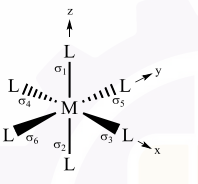
Consider the figure given below, where M is a metal and L is a monodentate ligand. The $\sigma$-bonding ligand group orbital (LGO) having same symmetry with $d_{z^2}$ orbital of M in the octahedral coordination geometry is
- Among the following, the compound with the lowest CO stretching frequency is
- The complex(es) that exhibit(s) optical isomerism is (are)
Among the given platinum(II) complexes, the one that is thermally the most unstable is
- According to Irving-Williams series, the number of d electrons for the first row transition metal (M) ion having the highest overall stability constant (log $\beta$) for $[M(EDTA)]^{2-}$ is ________
Need Expert Advice?


