
Gattermann-Koch Reaction Electrophile Identification
The Gattermann-Koch reaction is a method used for the formylation of aromatic compounds, notably in the industrial production of benzaldehyde.
The reaction involves treating an aromatic compound (like benzene) with carbon monoxide (CO) and hydrogen chloride (HCl) under high pressure, using a Lewis acid catalyst such as aluminum chloride ($AlCl_3$), often with cuprous chloride (CuCl) as a co-catalyst.
Electrophile Formation
The key step is the generation of the electrophile. Carbon monoxide (CO) reacts with hydrogen chloride (HCl) in the presence of the Lewis acid catalyst ($AlCl_3$) to form the highly reactive formyl cation, which is the electrophile.
The reaction generating the electrophile can be represented as:
$ CO + HCl \xrightarrow{AlCl_3} HCO^+ $This formyl cation ($HCO^+$) then attacks the aromatic ring, leading to formylation.
Analyzing the Options
- Option 1: $CO^+$ - This is the carbon monoxide cation, not the electrophile in this specific reaction.
- Option 2: $HCl + CO_2 + anhydrous\ AlCl_3$ - This combination is incorrect; the reaction uses carbon monoxide ($CO$), not carbon dioxide ($CO_2$).
- Option 3: $HCO^+$ - This is the formyl cation, the correct electrophile generated in the Gattermann-Koch reaction.
- Option 4: $CO + anhydrous\ AlCl_3$ - While these are reactants, they do not represent the active electrophile itself; HCl is also necessary to form $HCO^+$.
Therefore, the electrophile involved in the Gattermann-Koch reaction is the formyl cation ($HCO^+$).
Important Questions from Aldehydes, Ketones and Carboxylic Acids
Phenol is brominated in solvent CS₂ at low temperature. The product formed are:
What is not true regarding compound [B]?
(A) They are higher boiling liquids than aldehydes and ketones due to extensive H bonding
(B) They are soluble in Benzene
(C) They produce alkane when heated with soda lime
(D) Produces CO₂ when treated with NaHCO₃
Choose the correct answer from the options given below:
Which of the following is the correct statement for hybridization of C-atom and number of π bonds in the Carbonyl group?
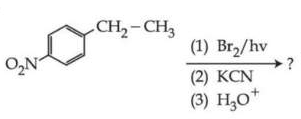
What is the product formed in the following reaction sequence?
What will be the product formed when cyclohexanone undergoes Aldol condensation?


