
h(0) Inverse Transform Relation
The value of a signal at time $t=0$, denoted as $h(0)$, is related to its Fourier Transform $H(j\omega)$ by the inverse Fourier Transform evaluated at $t=0$:
$h(0) = \frac{1}{2\pi} \int_{-\infty}^{\infty} H(j\omega) d\omega$
H(jω) Trigonometric Simplification
The given Fourier Transform is $H(j\omega) = \frac{(2\cos\omega)(\sin 2\omega)}{\omega}$. Using the trigonometric identity $2\cos A \sin B = \sin(A+B) - \sin(A-B)$, with $A=\omega$ and $B=2\omega$, the numerator becomes:
$2\cos\omega \sin 2\omega = \sin(\omega+2\omega) - \sin(\omega-2\omega) = \sin(3\omega) - \sin(-\omega) = \sin(3\omega) + \sin(\omega)$
Therefore, $H(j\omega)$ simplifies to:
$H(j\omega) = \frac{\sin(3\omega) + \sin(\omega)}{\omega}$
Integral of H(jω) Calculation
We calculate the integral $\int_{-\infty}^{\infty} H(j\omega) d\omega$:
$\int_{-\infty}^{\infty} H(j\omega) d\omega = \int_{-\infty}^{\infty} \frac{\sin(3\omega) + \sin(\omega)}{\omega} d\omega$
This integral can be split: $\int_{-\infty}^{\infty} \frac{\sin(3\omega)}{\omega} d\omega + \int_{-\infty}^{\infty} \frac{\sin(\omega)}{\omega} d\omega$
Using the standard integral result $\int_{-\infty}^{\infty} \frac{\sin(ax)}{x} dx = \pi \cdot \text{sgn}(a)$:
- $\int_{-\infty}^{\infty} \frac{\sin(3\omega)}{\omega} d\omega = \pi$ (since $a=3$)
- $\int_{-\infty}^{\infty} \frac{\sin(\omega)}{\omega} d\omega = \pi$ (since $a=1$)
The total integral is $\pi + \pi = 2\pi$.
Final h(0) Value Computation
Substitute the integral result back into the formula for $h(0)$:
$h(0) = \frac{1}{2\pi} \times (2\pi)$
$h(0) = 1$
Important Questions from Fourier Transform
- Match the LIST-I with LIST-IIChoose the correct answer from the options given below:
LIST-I LIST-II A. Continuous and periodic signal I. continuous time Fourier series B. Continuous and aperiodic signal II. discrete time Fourier series C. Discrete and periodic signal III. continuous time Fourier transform D. Discrete and aperiodic signal IV. discrete time Fourier transform - The Fourier transform of the signal $x(t)=e^{at}u(-t)$, $a0$ is
The Fourier transform for the given waveform.
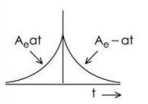
Fourier transform or Fourier integral of a function f(t) is given by
Match the following :
List - I List - II (spectrum |G(w)| in the original figure) (a) Rectangular Pulse (i) 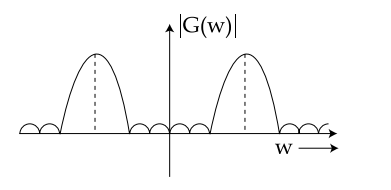
(b) Double-sided Exponential (ii) 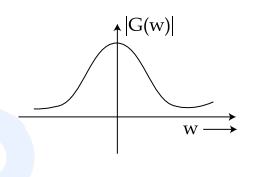
(c) Cosine Pulse (iii) 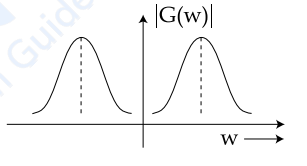
(d) Damped Sine (iv) 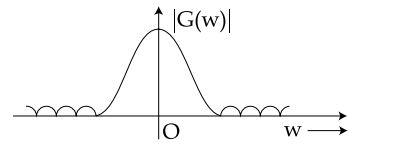
Codes :


