
The Fourier transform for the given waveform. 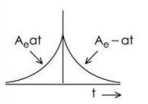
$\frac{A}{a-j\omega} + \frac{A}{a+j\omega}$
To find the Fourier transform of the given waveform, we observe that the signal is a combination of two exponential functions: \(A e^{at}\) and \(A e^{-at}\).
The waveform depicted in the image can be interpreted as the sum of two exponentially decaying functions:
- \(A e^{-at}\) for \(t \geq 0\)
- \(A e^{at}\) for \(t \lt 0\)
We need to calculate the Fourier transform of both components and then sum them up.
Fourier Transform of \(A e^{-at} \text{ for } t \geq 0\):
Using the standard formula, the Fourier transform is given by:
\(\int_{0}^{\infty} A e^{-at} e^{-j \omega t} dt = \frac{A}{a + j \omega}\)
Fourier Transform of \(A e^{at} \text{ for } t \lt 0\):
Similarly, using the standard formula, the Fourier transform is given by:
\(\int_{-\infty}^{0} A e^{at} e^{-j \omega t} dt = \frac{A}{a - j \omega}\)
Combining both results, the total Fourier Transform is:
\(\frac{A}{a - j \omega} + \frac{A}{a + j \omega}\)
Therefore, the correct answer is:
Correct Answer: \(\frac{A}{a-j\omega} + \frac{A}{a+j\omega}\)
Explanation of Incorrect Options:
- \(\frac{A}{a+j\omega}\) and \(\frac{A}{a-j\omega}\) are parts of the transform but not the complete answer.
- \(\frac{A}{a+j\omega} - \frac{A}{a-j\omega}\) represents the difference of the transforms, which is not applicable for this waveform.
Important Questions from Fourier Transform
- Match the LIST-I with LIST-IIChoose the correct answer from the options given below:
LIST-I LIST-II A. Continuous and periodic signal I. continuous time Fourier series B. Continuous and aperiodic signal II. discrete time Fourier series C. Discrete and periodic signal III. continuous time Fourier transform D. Discrete and aperiodic signal IV. discrete time Fourier transform - The Fourier transform of the signal $x(t)=e^{at}u(-t)$, $a0$ is
Fourier transform or Fourier integral of a function f(t) is given by
Match the following :
List - I List - II (spectrum |G(w)| in the original figure) (a) Rectangular Pulse (i) 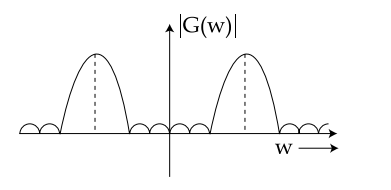
(b) Double-sided Exponential (ii) 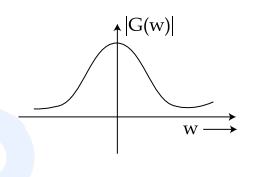
(c) Cosine Pulse (iii) 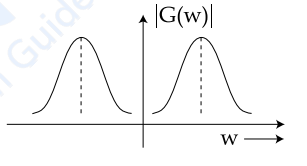
(d) Damped Sine (iv) 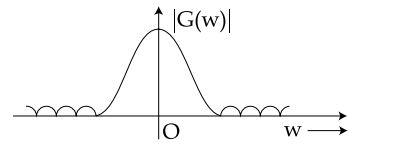
Codes :
A continuous real-valued signal $x(t)$ has finite positive energy and $x(t) = 0, \forall t < 0$. From the list given below, select ALL the signals whose continuous-time Fourier transform is purely imaginary.


