
LIST-I LIST-II A. Continuous and periodic signal I. continuous time Fourier series B. Continuous and aperiodic signal II. discrete time Fourier series C. Discrete and periodic signal III. continuous time Fourier transform D. Discrete and aperiodic signal IV. discrete time Fourier transform
This question requires matching signal types with their appropriate analysis tools based on whether they are continuous/discrete and periodic/aperiodic.
Signal Type and Analysis Tool Matching
We need to match the signal characteristics in LIST-I with the corresponding analysis methods in LIST-II:
- A. Continuous and periodic signal: Such signals are analyzed using the Continuous Time Fourier Series (CTFS).
- B. Continuous and aperiodic signal: These signals are analyzed using the Continuous Time Fourier Transform (CTFT).
- C. Discrete and periodic signal: The analysis tool for these signals is the Discrete Time Fourier Series (DTFS).
- D. Discrete and aperiodic signal: These signals are analyzed using the Discrete Time Fourier Transform (DTFT).
Correct Matching
Based on the analysis above, the correct matching is:
- A matches with I (Continuous Time Fourier Series)
- B matches with III (Continuous Time Fourier Transform)
- C matches with II (Discrete Time Fourier Series)
- D matches with IV (Discrete Time Fourier Transform)
Therefore, the correct combination is A-I, B-III, C-II, D-IV.
Important Questions from Fourier Transform
- The Fourier transform of the signal $x(t)=e^{at}u(-t)$, $a0$ is
The Fourier transform for the given waveform.
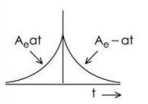
Fourier transform or Fourier integral of a function f(t) is given by
Match the following :
List - I List - II (spectrum |G(w)| in the original figure) (a) Rectangular Pulse (i) 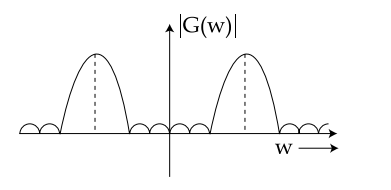
(b) Double-sided Exponential (ii) 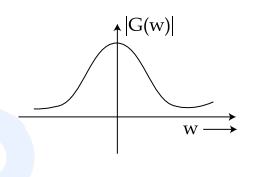
(c) Cosine Pulse (iii) 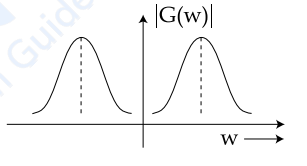
(d) Damped Sine (iv) 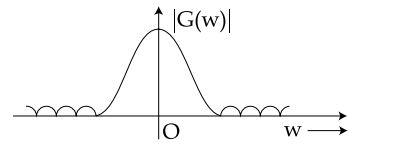
Codes :
A continuous real-valued signal $x(t)$ has finite positive energy and $x(t) = 0, \forall t < 0$. From the list given below, select ALL the signals whose continuous-time Fourier transform is purely imaginary.


