
$\frac{1}{a - j 2\pi f}$
Fourier Transform of the Exponential Decay Signal
This solution explains how to find the Fourier Transform of the signal defined as $x(t) = e^{at}u(-t)$, where $a > 0$. The Fourier Transform is a fundamental tool in signal processing used to analyze signals in the frequency domain.
Understanding the Signal
The signal $x(t)=e^{at}u(-t)$ consists of two parts:
- $e^{at}$: An exponential function. Since $a > 0$, this term grows as $t$ increases.
- $u(-t)$: The unit step function. This function is equal to 1 when its argument is non-negative (i.e., $-t \ge 0$ or $t \le 0$) and 0 when its argument is negative (i.e., $-t < 0$ or $t > 0$).
Combining these, the signal $x(t)$ is $e^{at}$ for $t \le 0$ and $0$ for $t > 0$. This represents an exponentially decaying signal as $t$ goes from $0$ towards negative infinity.
Fourier Transform Definition
The Fourier Transform of a continuous-time signal $x(t)$ is defined as: $ X(f) = \mathcal{F}\{x(t)\} = \int_{-\infty}^{\infty} x(t) e^{-j2\pi ft} dt $ where $f$ is the frequency and $j$ is the imaginary unit.
Derivation Steps
- Substitute the signal $x(t)$ into the Fourier Transform integral: $ X(f) = \int_{-\infty}^{\infty} \left( e^{at}u(-t) \right) e^{-j2\pi ft} dt $
- Apply the property of the unit step function $u(-t)$: Since $u(-t)$ is 1 only for $t \le 0$ and 0 otherwise, the integral limits change from $(-\infty, \infty)$ to $(-\infty, 0]$. $ X(f) = \int_{-\infty}^{0} e^{at} e^{-j2\pi ft} dt $
- Combine the exponential terms: Using the property $e^a e^b = e^{a+b}$, we can combine the exponents. $ X(f) = \int_{-\infty}^{0} e^{(a - j2\pi f)t} dt $
- Evaluate the integral: The integral of $e^{kt}$ is $\frac{1}{k}e^{kt}$. Here, $k = a - j2\pi f$. $ X(f) = \left[ \frac{e^{(a - j2\pi f)t}}{a - j2\pi f} \right]_{t=-\infty}^{t=0} $
-
Apply the limits of integration:
Evaluate the expression at the upper limit ($t=0$) and subtract the value at the lower limit ($t \to -\infty$).
- At $t=0$: $\frac{e^{(a - j2\pi f)(0)}}{a - j2\pi f} = \frac{e^0}{a - j2\pi f} = \frac{1}{a - j2\pi f}$
- As $t \to -\infty$: Since $a > 0$, the term $at$ in the exponent $(a - j2\pi f)t$ approaches $-\infty$. Therefore, $e^{(a - j2\pi f)t} \to 0$.
- Final Result: Subtracting the value at the lower limit from the value at the upper limit gives: $ X(f) = \frac{1}{a - j2\pi f} - 0 $ $ X(f) = \frac{1}{a - j2\pi f} $
Conclusion
The Fourier Transform of the signal $x(t)=e^{at}u(-t)$ for $a>0$ is $\frac{1}{a - j2\pi f}$. This matches option 3.
Important Questions from Fourier Transform
- Match the LIST-I with LIST-IIChoose the correct answer from the options given below:
LIST-I LIST-II A. Continuous and periodic signal I. continuous time Fourier series B. Continuous and aperiodic signal II. discrete time Fourier series C. Discrete and periodic signal III. continuous time Fourier transform D. Discrete and aperiodic signal IV. discrete time Fourier transform The Fourier transform for the given waveform.
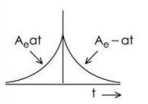
Fourier transform or Fourier integral of a function f(t) is given by
Match the following :
List - I List - II (spectrum |G(w)| in the original figure) (a) Rectangular Pulse (i) 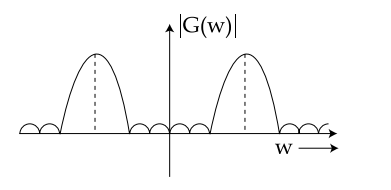
(b) Double-sided Exponential (ii) 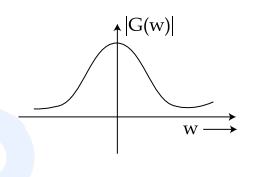
(c) Cosine Pulse (iii) 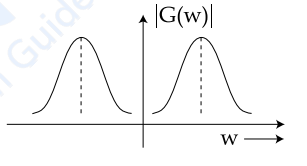
(d) Damped Sine (iv) 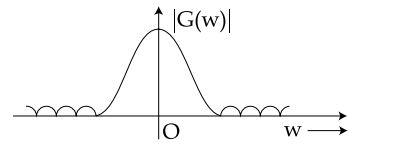
Codes :
A continuous real-valued signal $x(t)$ has finite positive energy and $x(t) = 0, \forall t < 0$. From the list given below, select ALL the signals whose continuous-time Fourier transform is purely imaginary.


