
The following table gives zone wise survey report of the people of a country who take tea. Study the table and answer the question. The ratio of the total number of people surveyed who take tea more than 3 times a day to the number of people who do not take tea at all is: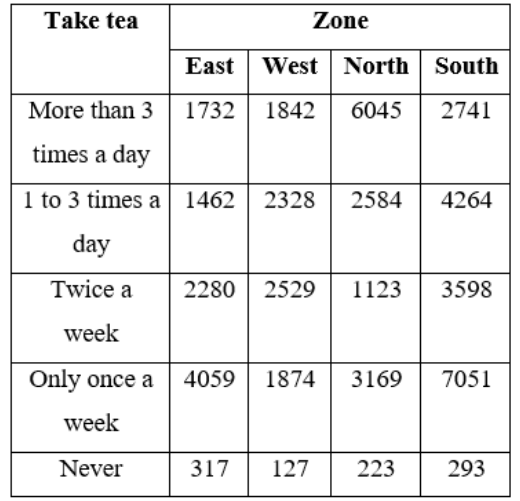
103 : 8
The required ratio can be found by dividing the number of people who take tea more than 3 times a day by those who do not take tea at all.
Similar Questions
The weighted aggregate price index with base year quantities taken as weights is known as:
If X ~ N(5,16), then the first quartile of X is equal to:
β2 of normal distribution is _____.
Which of the following is true?
If Q3 - Q2 > Q2 - Q1, the value of Bowley's coefficient of skewness is:
For the uniformly distributed random variable X with a = 0 and b = θ, the value of the ratio of raw moments (μ'3/μ'4) is.
If n1 = 10, n2 = 5 are the sizes of a male and female student group with mean ages x̄1 = 10, x̄2 = 4, respectively, with an equal standard deviation σ1 = σ2 = 1, the standard deviation of the combined series with size n1 + n2 and combined mean x̄ = 8 is equal to:
For the given distribution of female weight in a colony, the quartiles are 60.1, 61.3, 62.6. The value of Bowley's coefficient of skewness is:
The regression assumption is that the deviations from the regression line (residuals) follow a:
If the two lines of regression are x + 2y - 5 = 0 and 2x + 3y - 8 = 0, the means of X and Y are:
Important Questions from Statistics
Given below are two statements one is labelled as Assertion (A) and the other is labelled as
Reason (R).
Assertion (A): Additive model considers the total of various components resulting in the given
values of the over all time series and it is stated as:
$Y=T+C+S+I$
Reason (R): Multiplicative model assumes that the various components interact in a
multiplicative manner to produce the given values of the over all time series and
can be stated as $Y=T \times C \times S \times I$
In the light of the above statements, choose the most appropriate answer from the options given
below:
Match List - I with List - II.
List - I List - II A. Sample proportion P = x/n I. $\frac{\sigma}{\sqrt{n}}$ B. Sample variance $S_1^2 = \frac{1}{n-1} \sum_{i=1}^{n}(xi-x̄)^2$ II. $\sigma^2 \sqrt{\frac{2}{n}}$ C. Sample variance $S^2 = \frac{1}{n} \sum_{i=1}^{n}(xi-x̄)^2$ III. $\sigma^2 \sqrt{\frac{2}{(n-1)}}$ D. Sample mean $\bar{x} = \frac{1}{n} \sum_{i=1}^{n}xi$ IV. $\sqrt{\frac{\pi(1-\pi)}{n}}$
Choose the correct answer from the options given below :- The measurement or determinations of length, height, weight, volume, area, pressure etc. comes under:
- Which of the following options explain what a 'mean' assumes ?
(i) an interval level of measurement
(ii) a nominal level of measurement
(iii) an ordinal level of measurement
(iv) a ratio level of measurement - Match List I with List II:
List I List II (a) Alpha Level (I) The index of magnitude or strength of relationship (b) Level of Significance (II) The point at which one would reject the null hypothesis and accept the alternate hypothesis (c) Critical Region (III) Another name for alpha level (d) Effect size indicatior (IV) A marked area which would be called a rare event



