
The following is not a candidate material for Laser source in Fiber Optics
Phosphorous
Laser Sources in Fiber Optics
In the field of Fiber Optics, laser sources are crucial components responsible for generating the light signals that carry information through optical fibers. These sources must meet specific requirements, such as producing light at a particular wavelength, having a narrow spectral width, and maintaining high power and stability. Different materials are used as active media in lasers to produce light through stimulated emission.
Laser Candidate Materials for Fiber Optics
Several materials are commonly used as active media in various types of lasers, many of which find applications in fiber optic communication systems:
- Nd-YAG Laser: Nd-YAG stands for Neodymium-doped Yttrium Aluminum Garnet. This is a very common type of solid-state laser. Nd-YAG lasers are widely used in various applications, including medical procedures, material processing, and also in fiber optic systems due to their ability to produce high power at specific wavelengths (e.g., 1064 nm, 1320 nm). They are excellent candidates for laser sources.
- He-Ne Laser: He-Ne refers to Helium-Neon. This is a type of gas laser known for its stability and highly coherent output. He-Ne lasers typically emit red light at 632.8 nm, but can also produce other wavelengths. While less common for high-speed data transmission in modern fiber optics compared to semiconductor lasers, they are fundamental in optical alignment, teaching labs, and some sensing applications, proving them as viable laser sources.
- Argon Laser: Argon refers to an Argon-ion gas laser. Argon-ion lasers are known for producing multiple strong spectral lines in the blue-green visible light spectrum (e.g., 488 nm and 514.5 nm). They are high-power lasers used in various scientific, medical, and industrial applications, including some niche areas within fiber optics, especially for specific wavelength requirements or research purposes. Thus, Argon is a candidate material for laser generation.
Phosphorous and Laser Generation
Phosphorous is a chemical element (P) known for its phosphorescence (light emission after absorbing radiation) and fluorescence properties, especially in compounds. However, elemental phosphorous or its simple compounds are not typically used as the primary active medium for generating coherent laser light. Lasers require materials that can sustain a population inversion and efficiently undergo stimulated emission. While phosphorous can be an important dopant in certain optical materials or semiconductors (like in LEDs), it is not a standalone candidate material for the active gain medium in a laser source for fiber optics or any other primary laser application. The active media for lasers are usually specific types of crystals, glasses, gases, or semiconductors.
Therefore, among the given options, Phosphorous is not considered a candidate material for a laser source in Fiber Optics.
Important Questions from Laser
What is a DISADVANTAGE of LED lights over LASER lights?
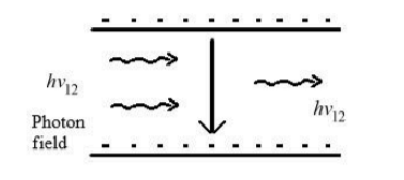
In a LASER device the instantaneous populations of energy $E_1$ and $E_2$ (figure below) to be $n_1$ and $n_2$ respectively. At thermal equilibrium the relative population is given by $n_2 = n_1e^{-h\nu_{12}/KT}$
The condition for population inversion when stimulated emission dominates is given by
The following are correct about a semiconductor LASER :
1. It requires population inversion
2. It has shorter lifetime than LED
3. It demonstrates spontaneous emission phenomenon
4. It generates monochromatic incoherent light.Find out the correct answer :
In comparison to LED, LASER has
1. high emission frequency
2. no tuning arrangement
3. narrow spectral bandwidth
4. provision for confinementWhich of the following conditions is applicable in semiconductor LASERs ?


