Effective Volume Calculation
The bioreactor is a plug flow reactor (PFR) with a total volume $V_{reactor} = 100 \, \text{L}$ and voidage $\epsilon = 0.55$. The effective volume available for the reaction is:
$ V_{eff} = V_{reactor} \times \epsilon = 100 \, \text{L} \times 0.55 = 55 \, \text{L} $
Bioconversion Rate Equation
The reaction follows Michaelis-Menten kinetics for immobilized enzymes, ignoring diffusional limitations. The rate of lactose consumption ($-r_A$) per unit effective volume is given by:
$ -r_A = \frac{V'_{max} C_A}{K'_m + C_A} $
Where:
- $C_A$ is the lactose concentration ($gl^{-1}$)
- $K'_m = 0.72 \, gl^{-1}$
- $V'_{max} = 18 \, gl^{-1}h^{-1}$
PFR Design Equation
For a PFR, the design equation relating volume, flow rate, and reaction rate is:
$ \frac{V_{eff}}{F_{A0}} = \int_{C_{A,out}}^{C_{A,in}} \frac{dC_A}{r_A} = \int_{C_{A,in}}^{C_{A,out}} \frac{dC_A}{(-r_A)} $
Substituting the Michaelis-Menten rate expression and the relationship $C_A = C_{A0}(1-X_A)$ ($C_{A,in} = C_{A0}$), the integrated form becomes:
$ \frac{V_{eff}}{F_{A0}} = \frac{K'_m \ln\left(\frac{C_{A0}}{C_{A,out}}\right) + (C_{A0} - C_{A,out})}{V'_{max}} $
Using $C_{A,out} = C_{A0}(1-X_A)$ and simplifying:
$ \frac{V_{eff}}{F_{A0}} = \frac{C_{A0} X_A - K'_m \ln(1-X_A)}{V'_{max}} $
Rearranging to solve for the feed flow rate $F_{A0}$:
$ F_{A0} = \frac{V_{eff} \cdot V'_{max}}{C_{A0} X_A - K'_m \ln(1-X_A)} $
Flow Rate Calculation
Given values:
- $V_{eff} = 55 \, \text{L}$
- $V'_{max} = 18 \, gl^{-1}h^{-1}$
- $C_{A0} = 20 \, gl^{-1}$
- $K'_m = 0.72 \, gl^{-1}$
- $X_A = 0.90$
Calculate the denominator:
$ C_{A0} X_A - K'_m \ln(1-X_A) = (20 \, gl^{-1})(0.90) - (0.72 \, gl^{-1}) \ln(1 - 0.90) $
$ = 18 \, gl^{-1} - (0.72 \, gl^{-1}) \ln(0.1) $
Using $\ln(0.1) \approx -2.3026$:
$ = 18 \, gl^{-1} - (0.72 \, gl^{-1})(-2.3026) $
$ = 18 \, gl^{-1} + 1.6579 \, gl^{-1} = 19.6579 \, gl^{-1} $
Calculate the numerator:
$ V_{eff} \cdot V'_{max} = 55 \, \text{L} \times 18 \, gl^{-1}h^{-1} = 990 \, gh^{-1} $
Calculate the feed flow rate $F_{A0}$:
$ F_{A0} = \frac{990 \, gh^{-1}}{19.6579 \, gl^{-1}} \approx 50.355 \, lh^{-1} $
Rounding to the nearest option, the required feed flow rate is approximately $50 \, lh^{-1}$.
Important Questions from Heterocyclic Chemistry
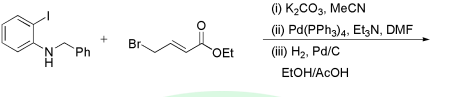
The major product formed in the following reaction sequences is
- The reaction(s) that yield(s) 2-methylquinoline as the major product is (are)
- Which one of the following bioreactor configurations is the basis for a trickling biological filter?
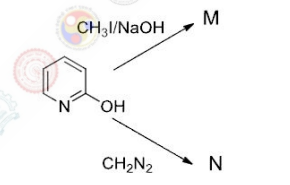
The major products M and N formed in the following reactions are
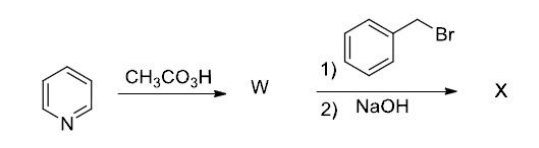
The structures of the major products W and X in the following synthetic scheme are