The dimension of the universal constant of gravitation, \(G\), is
\([\mathrm{M^{-1}L^3T^{-2}}]\)
Newton's law of gravitation: \(F = \frac{Gm_1m_2}{r^2}\), so \(G = \frac{Fr^2}{m_1m_2}\).
Dimensions: \([F] = [\mathrm{MLT^{-2}}]\), \([r^2] = [\mathrm{L^2}]\) and \([m_1m_2] = [\mathrm{M^2}]\).
Therefore \([G] = \frac{[\mathrm{MLT^{-2}}][\mathrm{L^2}]}{[\mathrm{M^2}]} = [\mathrm{M^{-1}L^3T^{-2}}]\).
Check: in SI units \(G = 6.67\times10^{-11}\ \mathrm{N\,m^2\,kg^{-2}} = 6.67\times10^{-11}\ \mathrm{m^3\,kg^{-1}\,s^{-2}}\), which matches.
Hence, the answer is \([\mathrm{M^{-1}L^3T^{-2}}]\).
Similar Questions
- Density and volume of a body are given as $(20 \pm 4)\text{ gm/cm}^3$ and $(10 \pm 1)\text{ cm}^3$ respectively. The absolute error in measurement of mass is
- The velocity $v$ of a particle at time $t$ is given by $v = at + \frac{b}{t+c}$, where $a$, $b$ and $c$ are constants. The dimension of $a$, $b$ and $c$ are, respectively
A modified gravitational potential is given by \(V=-\dfrac{GM}{r}+\dfrac{A}{r^{2}}\). If the constant A is expressed in terms of gravitational constant (G), mass (M) and velocity of light (c), then from dimensional analysis, A is,
In an experiment, the length of an object is measured to be 6.50 cm. This measured value can be written as 0.0650 m. The number of significant figures on 0.0650 m is
If the dimensions of length are expressed as GxCyhz, where G, C and h are the universal gravitational constant, speed of light and Planck’s constant respectively, then
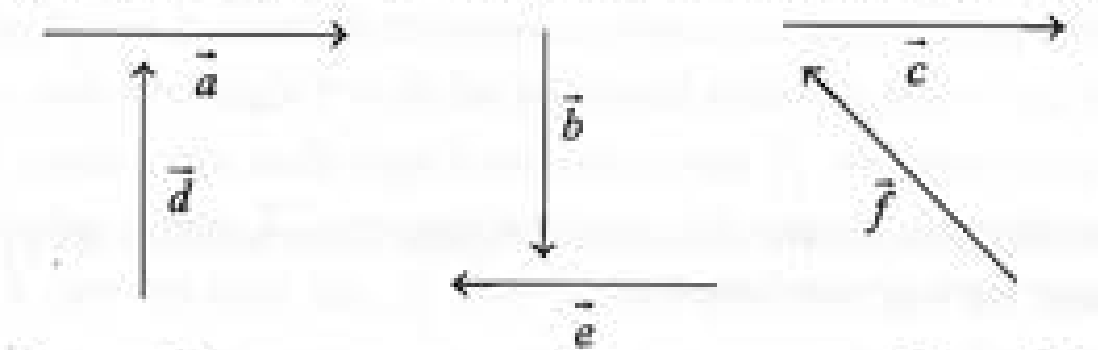
Six vectors \(\vec{a},\vec{b},\vec{c},\vec{d},\vec{e}\) and \(\vec{f}\) have the magnitudes and directions indicated in the figure. Which of the following statements is true?
The resistance \(R=\dfrac{V}{I}\) where V = (25 ± 0.4) Volt and I = (200 ± 3) Ampere. The percentage error in ‘R’ is
A quantity X is given by \(\varepsilon_0L\dfrac{\Delta V}{\Delta t}\), where ε0 is the permittivity of free space, L is the length, ΔV is a potential difference and Δt is a time interval. The dimension of X is same as that of
Three vectors \(\vec{A} = a\vec{i} + \vec{j} + \vec{k}\); \(\vec{B} = \vec{i} + b\vec{j} + \vec{k}\) and \(\vec{C} = \vec{i} + \vec{j} + c\vec{k}\) are mutually perpendicular (\(\vec{i}, \vec{j}\) and \(\vec{k}\) are unit vectors along X, Y and Z axis respectively). The respective values of a, b and c are
- In a triangle $ ABC$, the sides $ AB$ and $ AC$ are represented by the vectors $ 3\hat{\mathrm{i}}+\hat{\mathrm{j}}+\hat{\mathrm{k}}$ and $ \hat{\mathrm{i}}+2\hat{\mathrm{j}}+\hat{\mathrm{k}},$ respectively. Calculate the angle $ \angle ABC.$
Important Questions from General Physics
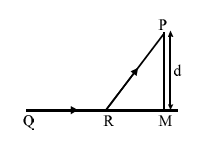
A man in a car at location Q on a straight highway is moving with speed v. He decides to reach a point P in qa field at a distance d from the highway (point m) as shown in the figure. Speed of the car in the field is half to that on the highway. What should be the distance RM, so that the time taken to reach P is minimum ?
- Three particles P, Q and R are moving along the vectors $\vec{A} = \hat{i} + \hat{j}$, $\vec{B} = \hat{j} + \hat{k}$ and $\vec{C} = -\hat{i} + \hat{j}$ respectively. They strike on a point and start to move in different directions.<br>Now particle P is moving normal to the plane which contains vector $\vec{A}$ and $\vec{B}$. Similarly particle Q is moving normal to the plane which contains vector $\vec{A}$ and $\vec{C}$. The angle between the direction of motion of P and Q is $\cos^{-1}\left(\frac{1}{\sqrt{x}}\right)$. Then the value of x is __________.
Three students $S_1$, $S_2$ and $S_3$ perform an experiment for determining the acceleration due to gravity (g) using a simple pendulum. They use different lengths of pendulum and record time for different number of oscillations. The observations are as shown in the table.
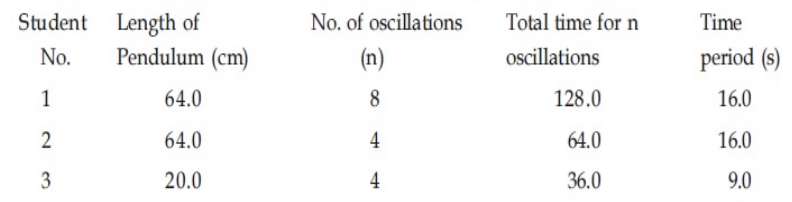
(least count of length =0.1 cm
least count for time =0.1s )
If $E_1$, $E_2$ and $E_3$ are the percentage errors in 'g' for students 1, 2 and 3 respectively, then the minimum percentage error is obtained by student no. __________.
- Let PQR be a triangle such that $\vec{PQ} = -2\hat{i} - \hat{j} + 2\hat{k}$ and $\vec{PR} = a\hat{i} + b\hat{j} - 4\hat{k}$, $a, b \in \mathbb{Z}$. Let S be the point on QR, which is equidistant from the lines PQ and PR. If $|\vec{PR}| = 9$ and $\vec{PS} = \hat{i} - 7\hat{j} + 2\hat{k}$, then the value of $3a - 4b$ is ________
- Given a charge $q$, current $I$ and permeability of vacuum $\mu_o$. Which of the following quantity has the dimension of momentum ?