
Understanding Cobalt Complex Isomerism
The question presents two cobalt coordination complexes:
- Complex 1: $[Co(H_2O)_4Cl_2]NO_2$
- Complex 2: $[Co(H_2O)_4Cl(NO_2)]Cl$
We need to determine the type of isomerism they exhibit.
Analyzing the Complex Structures
Observe the components of each complex:
- Coordination Sphere: In both complexes, the coordination sphere contains one Cobalt (Co) ion, four water molecules ($H_2O$), and one chloride ion ($Cl^-$).
- Counter Ion: The ion outside the coordination sphere differs.
- In Complex 1, the counter ion is the nitrite ion ($NO_2^-$).
- In Complex 2, the counter ion is the chloride ion ($Cl^-$).
The key difference is the exchange of a ligand within the coordination sphere ($Cl^-$) and the counter ion ($NO_2^-$). Specifically, the $NO_2$ group acts as the counter ion in the first complex but as a ligand in the second complex. Conversely, a $Cl^-$ ion acts as a ligand in the first complex and is the counter ion in the second.
Defining Ionization Isomers
Ionization isomers are coordination compounds that have the same molecular formula but differ in the ions present inside and outside the coordination sphere. The ion outside the coordination sphere in one isomer acts as a ligand within the coordination sphere in the other isomer, and vice versa.
Conclusion on Isomer Type
Based on the analysis:
- Complex 1: $[Co(H_2O)_4Cl_2]NO_2$ (Nitrite ion is the counter ion)
- Complex 2: $[Co(H_2O)_4Cl(NO_2)]Cl$ (Chloride ion is the counter ion, Nitrite ion is a ligand)
The nitrite ion ($NO_2^-$), which is the counter ion in Complex 1, is a ligand in Complex 2. The chloride ion ($Cl^-$), which is a ligand in Complex 1, is the counter ion in Complex 2. This direct exchange between a ligand and the counter ion defines ionization isomerism.
Therefore, the complexes are ionization isomers.
Important Questions from Coordination Chemistry
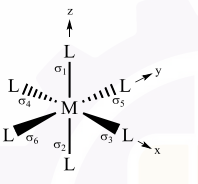
Consider the figure given below, where M is a metal and L is a monodentate ligand. The $\sigma$-bonding ligand group orbital (LGO) having same symmetry with $d_{z^2}$ orbital of M in the octahedral coordination geometry is
- Among the following, the compound with the lowest CO stretching frequency is
- The complex(es) that exhibit(s) optical isomerism is (are)
Among the given platinum(II) complexes, the one that is thermally the most unstable is
- According to Irving-Williams series, the number of d electrons for the first row transition metal (M) ion having the highest overall stability constant (log $\beta$) for $[M(EDTA)]^{2-}$ is ________


