
To determine which complex exists as a pair of enantiomers, we need to identify the chiral complex among the given options. Chirality in coordination complexes arises from the absence of symmetry elements like a plane of symmetry (σ) or a center of symmetry (i).
Chirality Analysis of Complexes
-
Option 1: $trans-[Co(H_2NCH_2CH_2NH_2)_2Cl_2]^+$
- This is an octahedral complex of the type [MA2B2], where A is the bidentate ligand ethylenediamine (en) and B is the monodentate ligand chloride (Cl).
- The trans isomer, with the two Cl- ligands opposite each other, possesses a plane of symmetry.
- Therefore, this complex is achiral.
-
Option 2: $cis-[Co(NH_3)_4Cl_2]^+$
- This is an octahedral complex of the type [MA4B2], where A is ammonia (NH3) and B is chloride (Cl).
- The cis isomer, with the two Cl- ligands adjacent, has a plane of symmetry passing through the metal and the two Cl ligands.
- Therefore, this complex is achiral.
-
Option 3: $[Pt(PPh_3)(Cl)(Br)(CH_3)]^-$
- This is a square planar complex with four different monodentate ligands: PPh3, Cl, Br, and CH3.
- A square planar complex with four distinct ligands is typically chiral.
-
Option 4: $[Co(H_2NCH_2CH_2NH_2)_3]^{3+}$
- This is an octahedral complex of the type [M(AA)3]n+, where AA is the symmetrical bidentate ligand ethylenediamine (en).
- Complexes of the type [M(AA)3]n+, with symmetrical bidentate ligands like ethylenediamine, lack any plane or center of symmetry.
- The arrangement of the three ethylenediamine ligands around the central cobalt ion creates a chiral structure.
- Therefore, this complex exists as a pair of enantiomers.
Conclusion on Enantiomers
The complex that exhibits chirality and exists as a pair of enantiomers is the one lacking symmetry elements. Based on the analysis, the complex $[Co(H_2NCH_2CH_2NH_2)_3]^{3+}$ fits this criterion.
Important Questions from Coordination Chemistry
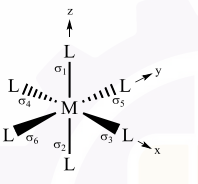
Consider the figure given below, where M is a metal and L is a monodentate ligand. The $\sigma$-bonding ligand group orbital (LGO) having same symmetry with $d_{z^2}$ orbital of M in the octahedral coordination geometry is
- Among the following, the compound with the lowest CO stretching frequency is
- The complex(es) that exhibit(s) optical isomerism is (are)
Among the given platinum(II) complexes, the one that is thermally the most unstable is
- According to Irving-Williams series, the number of d electrons for the first row transition metal (M) ion having the highest overall stability constant (log $\beta$) for $[M(EDTA)]^{2-}$ is ________


