
The angle of elevation of the top of a tower from the top of a building whose height is 680 m is 45° and the angle of elevation of the top of same tower from the foot of the same building is 60°. What is the height (in m) of the tower?
340(3 + √3)
Understanding the Problem: Tower and Building Height
This problem involves trigonometry, specifically using angles of elevation to find the height of a tower. We are given the height of a building and the angles of elevation to the top of the tower from two different points: the top of the building and the foot of the building.
Let's define the key elements:
- Height of the building = 680 m
- Angle of elevation from the top of the building to the top of the tower = 45°
- Angle of elevation from the foot of the building to the top of the tower = 60°
- We need to find the height of the tower.
Setting up the Geometry
Imagine a vertical tower and a vertical building some distance apart on level ground. Let:
- \(H\) be the height of the tower.
- \(x\) be the horizontal distance between the foot of the building and the foot of the tower.
We can visualize two right-angled triangles formed by these elements and the lines of sight corresponding to the angles of elevation.
Applying Trigonometry (Tangent Function)
The tangent of an angle in a right-angled triangle is the ratio of the opposite side to the adjacent side.
From the Foot of the Building:
The angle of elevation from the foot of the building to the top of the tower is 60°. The opposite side is the height of the tower (\(H\)), and the adjacent side is the horizontal distance between the building and the tower (\(x\)).
So, we have:
\(\tan(60^\circ) = \frac{\text{Height of Tower}}{\text{Distance between Building and Tower}}\)
\(\tan(60^\circ) = \frac{H}{x}\)
We know that \(\tan(60^\circ) = \sqrt{3}\). Therefore:
\(\sqrt{3} = \frac{H}{x}\)
This gives us our first equation:
Equation 1: \(H = x\sqrt{3}\)
From the Top of the Building:
The height of the building is 680 m. The angle of elevation from the top of the building to the top of the tower is 45°. The line of sight from the top of the building to the top of the tower is parallel to the ground. The vertical distance from the level of the top of the building up to the top of the tower is \(H - 680\) m. The horizontal distance is still \(x\).
So, we have:
\(\tan(45^\circ) = \frac{\text{Vertical distance from top of building to top of tower}}{\text{Distance between Building and Tower}}\)
\(\tan(45^\circ) = \frac{H - 680}{x}\)
We know that \(\tan(45^\circ) = 1\). Therefore:
\(1 = \frac{H - 680}{x}\)
This gives us our second equation:
Equation 2: \(x = H - 680\)
Solving for the Height of the Tower
Now we have a system of two linear equations with two variables, \(H\) and \(x\). We can substitute the expression for \(x\) from Equation 2 into Equation 1.
Substitute \(x = H - 680\) into \(H = x\sqrt{3}\):
\(H = (H - 680)\sqrt{3}\)
Distribute \(\sqrt{3}\) on the right side:
\(H = H\sqrt{3} - 680\sqrt{3}\)
Now, we need to isolate \(H\). Move the term with \(H\) from the right side to the left side:
\(H - H\sqrt{3} = -680\sqrt{3}\)
Factor out \(H\) from the terms on the left side:
\(H(1 - \sqrt{3}) = -680\sqrt{3}\)
To get a positive coefficient for \(H\), multiply both sides by -1:
\(H(\sqrt{3} - 1) = 680\sqrt{3}\)
Now, divide by \((\sqrt{3} - 1)\) to solve for \(H\):
\(H = \frac{680\sqrt{3}}{\sqrt{3} - 1}\)
To simplify and rationalize the denominator, multiply the numerator and the denominator by the conjugate of the denominator, which is \((\sqrt{3} + 1)\):
\(H = \frac{680\sqrt{3}}{(\sqrt{3} - 1)} \times \frac{(\sqrt{3} + 1)}{(\sqrt{3} + 1)}\)
Multiply the numerators:
\(680\sqrt{3}(\sqrt{3} + 1) = 680(\sqrt{3} \times \sqrt{3} + \sqrt{3} \times 1) = 680(3 + \sqrt{3})\)
Multiply the denominators using the difference of squares formula \((a-b)(a+b) = a^2 - b^2\):
\((\sqrt{3} - 1)(\sqrt{3} + 1) = (\sqrt{3})^2 - (1)^2 = 3 - 1 = 2\)
So, the expression for \(H\) becomes:
\(H = \frac{680(3 + \sqrt{3})}{2}\)
Finally, divide 680 by 2:
\(H = 340(3 + \sqrt{3})\)
The height of the tower is \(340(3 + \sqrt{3})\) meters.
Conclusion
Based on the angles of elevation and the height of the building, the height of the tower is calculated to be \(340(3 + \sqrt{3})\) m.
Revision Table: Key Concepts
| Concept | Description | Relevance to Problem |
|---|---|---|
| Angle of Elevation | The angle between the horizontal line from the observer's eye to an object and the line of sight upwards to the object. | Used to set up trigonometric equations based on viewing the tower top. |
| Trigonometric Ratios (Tangent) | Relates the angles of a right-angled triangle to the ratio of its sides (\(\tan \theta = \text{Opposite} / \text{Adjacent}\)). | Essential for translating the angle information into equations involving the heights and distances. |
| Solving Systems of Equations | Finding the values of variables that satisfy multiple equations simultaneously. | Needed to find the unknown height (\(H\)) using the two equations derived from the two angles of elevation. |
| Rationalizing Denominators | Process of eliminating radicals from the denominator of a fraction. | Used to simplify the final expression for the tower's height into a standard form. |
Additional Information: Angles in Trigonometry
Understanding angles of elevation and depression is crucial in solving problems related to heights and distances.
- Angle of Elevation: When you look *up* at an object, the angle between your horizontal line of sight and your line of sight to the object is the angle of elevation.
- Angle of Depression: When you look *down* at an object, the angle between your horizontal line of sight and your line of sight to the object is the angle of depression. The angle of depression from point A to point B is equal to the angle of elevation from point B to point A, assuming the horizontal line is the same level.
Commonly used trigonometric values in these types of problems include:
| Angle (\(\theta\)) | \(\tan(\theta)\) | \(\sin(\theta)\) | \(\cos(\theta)\) |
|---|---|---|---|
| 30° | \(1/\sqrt{3}\) | \(1/2\) | \(\sqrt{3}/2\) |
| 45° | \(1\) | \(1/\sqrt{2}\) | \(1/\sqrt{2}\) |
| 60° | \(\sqrt{3}\) | \(\sqrt{3}/2\) | \(1/2\) |
These standard values help in quickly solving trigonometric equations encountered in height and distance problems.
Similar Questions
A person standing at a distance looks at a building having a height of 1000 metres. The angle between the top of the building and the ground is 30°. At what approximate distance (in metres) is the person standing away from the building.
Two ships are on the opposite of a light house such that all three of them are collinear. The angles of depression of the two ships from the top of the light house are 30° and 60°. If the ships are 230√3 m apart, then find the height of the light house (in m).
- A pole 23 m long reaches a window which is 3 \(\sqrt5\) m above the ground on one side of a street. Keeping its foot at the same point, the pole is turned to the other side of the street to reach a window 4 \(\sqrt15\) m high. What is the width (in m) of the street?
A person from the top of a hill observes a vehicle moving towards him at a uniform speed. It takes 10 minutes for the angle of depression to change from 45° to 60°. After this the time required by the vehicle to reach the bottom of the hill is
Two pillars A and B of the same height are on opposite sides of a road which is 40 m wide. The angles of elevation of the tops of the pillars A and B are 30° and 45°, respectively, at a point on the road between the pillars. What is the distance (in m) of the point from the foot of pillar A?
From the top of a hill 240 m high, the angles of depression of the top and bottom of a pole are 30° and 60°, respectively. The difference (in m) between the height of the pole and its distance from the hill is:
The length of the shadow of a vertical tower on level ground increases by 10 m when the altitude of the sun changes from 45° to 30°. The height of the tower is:
A vertical tower stands on a horizontal plane and a surmounted by a vertical flagstaff of height h. At a point on the plane, the angle of elevation of the bottom of the flagstaff is α and that of the top of the flagstaff is β. Then the height of the tower is
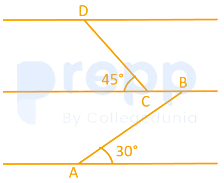
Two ladders AB and CD are inclined on two floors of a building as shown below, such that BC = √2 m. If the height of a floor is 4√2 m, how much minimum distance is to be covered to walk from point A to point D?
A vertical pole and a vertical tower are on the same level ground in such a way that, from the top of the pole, the angle of elevation of the top of the tower is 60° and the angle of depression of the bottom of the tower is 30°. If the height of the pole is 24 m, then find the height of the tower (in m).
Important Questions from Heights and Distances
A peacock sitting at the top of a 3 meter high pole saw a snake approaching towards pole at a distance three times of the height of the pole. Then it jumping from pole will catch the snake at what distance from the pole if both are running with same speed ?
The foot of a ladder 25 m long is 7 m from the base of the building. If the top of the ladder slips by 4 m, then by how much distance will the foot of the ladder slide?
Two hotels stand 25 m apart. One of them is 70 m high and the angle of depression of the top of other as observed from the top of this hotel is 45°. Height of the other hotel is:
If the angles of elevation of a balloon from two consecutive kilometer-stones along a straight road are 30° and 60° respectively, then the height of the balloon above the ground will be:
The angle of elevation of the top of a tower from a point 20 m away from its base is 45 °. What is the height of the tower?



