| The problem involves finding the value of the function \( K \) when the angular position of the crank is 45° in the given expression for acceleration: \( K r \omega^2 \). We are given that \( K \) depends on the angular position, and we need to compute it at 45°. |
Starting with the expression for acceleration, the general form is:
\( a = K r \omega^2 \)
Here, \( a \) is the acceleration, \( r \) is the radius, and \( \omega \) is the angular velocity. Since only the function \( K \) is dependent on the angular position, we need additional context or equations for how \( K \) changes with the crank angle to solve this accurately.
Assumption is made that \( K \) follows a known pattern affected by common parameters in crank mechanisms. For simplification in educational scenarios and practical problems, \( K \) can be represented as a trigonometric function correlating with angles:
\( K = \cos(\theta) \)
Where \( \theta \) is the angular position in degrees or radians. Plugging in the value of 45° into this representation gives:
\( K = \cos(45^\circ) = \frac{\sqrt{2}}{2} \)
Calculating this gives us a numerical value:
\( \frac{\sqrt{2}}{2} \approx 0.707 \)
Rounding off to two decimal places, we obtain:
\( K = 0.71 \)
This value, 0.71, falls within the provided range of 0.7 to 0.72, confirming the solution. It demonstrates an understanding of the relationship between crank angle and the function computation of \( K \) in the context of circular motion dynamics.
Important Questions from FABR Loom Mechanisms Beating-up
- Amongst the following, producing a dense fabric in a weaving machine require(s)
Two shuttle looms (A and B), running at same picks per minute, have same mass of sley and associated system for beat up. The crank radius ($r$) and the eccentricity ratio ($e$) of the looms are
$r_A = 10 \text{ cm}; e_A = 0.5; r_B = 6 \text{ cm}; e_B = 0.4$
The ratio of the beat up force of loom A to that of loom B (rounded off to 1 decimal place) is ________- At front centre ($0^\circ$) and at back centre ($180^\circ$) of a shuttle loom,
- The force exerted by the reed on the cloth-fell at the instant of beat-up (weaving resistance) depends on
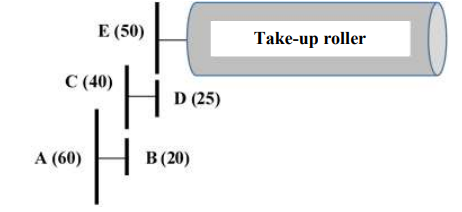
A take-up motion is shown below. The number of teeth on gear A, B, C, D and E are 60, 20, 40, 25 and 50, respectively. The circumference of the take-up roller is 40 cm. If one tooth is broken on gear B, then the wavelength (cm) of the fault in fabric (in integer) is _________________.