
Tab washers are used:
for locking the nuts
Understanding Tab Washers and Their Use
The question asks about the primary function of tab washers. Tab washers are a specific type of washer designed for a particular purpose in mechanical assemblies. Let's look at the options provided and determine which best describes their function.
What is a Tab Washer?
A tab washer is a type of locking washer. It is typically a flat washer with one or more tabs extending from its outer or inner circumference. These tabs are the key feature that distinguishes them from standard flat washers and gives them their locking capability.
Analysis of the Options
- Option 1: for locking the nuts
This option suggests that tab washers are used to prevent nuts (and bolts) from loosening. This aligns with the common understanding of how locking washers, including tab washers, function. - Option 2: to maintain bore diameter
Washers generally distribute the load of a fastener, which helps prevent damage to the mating surface and can indirectly support joint integrity, but their primary role is not to precisely maintain the bore diameter of a hole. - Option 3: for dimensional accuracy
While washers are manufactured to certain tolerances, their use is not primarily for achieving high dimensional accuracy within an assembly itself, unlike precision shims or spacers designed for that specific purpose. - Option 4: for structural assemblies
Tab washers are indeed used in structural and mechanical assemblies, but this option describes the general environment of use rather than the specific function of the tab washer itself. Many types of fasteners and components are used in structural assemblies.
Function of Tab Washers: Locking Nuts
The unique design of the tab washer, with its bendable tabs, is specifically intended for locking. Here’s how they work to lock nuts or bolts:
- The tab washer is placed under the nut or bolt head, against the mating surface.
- One tab is bent upwards or downwards to engage with a feature on the mating part, such as the side of the component or a slot.
- Once the nut or bolt is tightened, another tab is bent upwards or downwards to engage with a flat on the nut or the side of the bolt head.
- This bending of the tabs against both the mating surface and the fastener head creates a mechanical lock that resists rotation and prevents the nut or bolt from loosening due to vibration or other dynamic forces.
This locking method is particularly effective in critical applications where fastener loosening could lead to failure or safety hazards.
Why Other Options Are Less Accurate
While a washer is part of an assembly (Option 4), its specific contribution as a tab washer is the locking mechanism. They are not primarily used for maintaining bore diameter (Option 2) or ensuring high dimensional accuracy (Option 3). Their defining function is related to fastener retention by preventing rotation.
Conclusion on Tab Washer Use
Based on the design and mechanism of tab washers, their primary and intended use is to provide a positive locking action for nuts and bolts, preventing them from becoming loose. Therefore, the most accurate description of their use is for locking the nuts (and implicitly, the associated bolt or stud).
The correct use of tab washers significantly enhances the reliability and safety of mechanical joints, especially in environments subject to vibration or shock.
| Feature | Primary Function | Benefit |
|---|---|---|
| Tabs (bendable) | Mechanical locking of fasteners (nuts/bolts) | Prevents loosening due to vibration, enhances joint reliability |
| Flat body | Load distribution | Protects mating surface, distributes clamping force |
Revision Table: Tab Washer Application
| Aspect | Description | Relevance to Question |
|---|---|---|
| Definition | Washer with bendable tabs. | Helps understand its mechanism. |
| Main Purpose | To prevent fastener rotation and loosening. | Directly answers the question. |
| How it Works | Tabs are bent against the component and fastener. | Explains the locking action. |
| Comparison | Different from flat washers, which don't lock. | Highlights its specific role. |
Additional Information on Locking Washers
Tab washers are one type of locking washer. Other types of locking washers include:
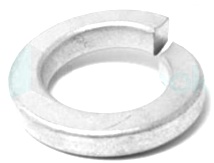
- Split Lock Washers: These have a single coil with sharp edges that dig into the nut/bolt and the mating surface to resist loosening.
- External Tooth Lock Washers: These have serrations or "teeth" around the outer diameter that bite into the mating surfaces.
- Internal Tooth Lock Washers: Similar to external tooth washers, but the teeth are on the inner diameter.
- Spring Washers (e.g., Curved, Wave): These provide a spring force to maintain tension in the joint, helping to resist loosening.
Each type of locking washer has specific applications where it is most effective, depending on factors like the environment (vibration, temperature), the materials being joined, and the required level of locking force. Tab washers are often used in conjunction with plain fasteners in critical applications where positive mechanical locking is required and there are suitable surfaces or features to bend the tabs against.
Similar Questions
Identify the part shown in the following figure.
Torque wrench is used for:
What is the name of the device shown in the picture?
Identify the tool in the given figure.
Which type of washer is used for locking a nut?
How can we remove a broken bolt from a tapped hole?
Allen key is also known as a/an ___________.
Spring washers are used under nuts to prevent _______.
What are Tab washers used for?
Identify the locking arrangement in the following figure.
Important Questions from Fasteners
Identify the part shown in the following figure.
Torque wrench is used for:
What is the name of the device shown in the picture?
Identify the tool in the given figure.
Which type of washer is used for locking a nut?



