
Spring washers are used under nuts to prevent _______.
loosening and fastening of nuts due to vibration
Understanding Spring Washers and Preventing Loosening
Spring washers are essential components used in bolted joints. Their primary function is to provide a degree of elasticity and tension, which helps maintain the clamping force between the nut and the bolt, especially under dynamic conditions like vibration.
Why Spring Washers are Used
Bolted joints can become loose over time due to various factors, including:
- Vibration: Movement and oscillation can cause the nut to rotate relative to the bolt threads.
- Thermal Expansion/Contraction: Changes in temperature can alter the dimensions of the bolt, nut, and joined parts, reducing clamping force.
- Creep or Relaxation: Materials under sustained load can deform over time, leading to loss of tension.
Spring washers are designed to counteract some of these effects. By deforming slightly under load, they store potential energy. If the joint tries to loosen (e.g., due to vibration), the spring washer expands slightly, maintaining pressure and friction between the threads of the bolt and nut, and between the nut and the work surface. This increased friction and constant tension resist the unscrewing motion caused by vibration.
Analyzing the Options for Spring Washer Usage
Let's look at the given options in the context of why spring washers are used:
- damage to the bolt: Spring washers are placed under the nut or sometimes under the bolt head. Their purpose is not directly to prevent damage to the bolt itself, though maintaining a secure joint can indirectly protect components.
- damage to the thread: While a secure joint prevents excessive movement that *could* potentially damage threads over time, the main role of the spring washer is not thread protection but preventing loosening.
- damage to the work: Flat washers are commonly used to distribute the load and prevent damage to the surface of the material being fastened. While a spring washer might offer some load distribution, its primary function is tension maintenance, not surface protection.
- loosening and fastening of nuts due to vibration: This option directly addresses the key benefit of using spring washers. They are specifically employed in applications subject to vibration to prevent the nuts from loosening (unscrewing) and losing the clamping force required for a secure joint. "Fastening" in this context likely refers to maintaining the secure fastening status, preventing it from becoming unfastened (loose).
Based on their design and application, the primary purpose of spring washers is to prevent the nut from loosening when subjected to vibration, shock, or minor thermal changes.
Conclusion on Spring Washer Function
The most accurate description of the function of spring washers among the given options is preventing the loosening of nuts, particularly in environments where vibration is a factor. They help maintain the necessary clamping force.
Revision Table: Key Concepts
| Component | Primary Function | Context in Bolted Joint |
|---|---|---|
| Bolt | Provides threaded stud and head for fastening | Carries the tensile load |
| Nut | Engages with bolt threads to create clamping force | Applies pressure to the joint |
| Flat Washer | Distributes load, protects surface, provides smooth bearing surface | Used under nut or bolt head |
| Spring Washer | Provides tension to resist loosening | Used under nut (most common) or bolt head |
Additional Information: Types and Applications
There are different types of spring washers, each with slightly varying characteristics:
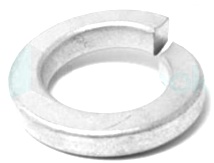
- Split Lock Washer: The most common type, designed to dig into the nut and the work surface slightly when tightened, providing a spring action.
- Helical Spring Washer: Similar to split lock washers but often flatter.
- Wave Washer: Has a wavy shape, providing a relatively small amount of spring action suitable for applications with limited axial space.
- Curved Washer: Simple disc shape with a curve, offering a gentle spring force.
Spring washers are widely used in various industries, including automotive, construction, and manufacturing, wherever bolted joints are subjected to dynamic loads or vibrations.
Similar Questions
Identify the part shown in the following figure.
Torque wrench is used for:
What is the name of the device shown in the picture?
Identify the tool in the given figure.
Which type of washer is used for locking a nut?
How can we remove a broken bolt from a tapped hole?
Allen key is also known as a/an ___________.
What are Tab washers used for?
Identify the locking arrangement in the following figure.
Tab washers are used:
Important Questions from Fasteners
Identify the part shown in the following figure.
Torque wrench is used for:
What is the name of the device shown in the picture?
Identify the tool in the given figure.
Which type of washer is used for locking a nut?



