
Select the Venn diagram that best illustrates the relationship between the following classes. Reptiles, Alligators, Animals

The least possible Venn diagram for the given relations is as shown below :
- All Alligators are Reptiles.
- All Reptiles are Animals.
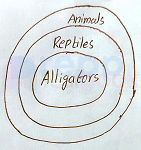
Hence, the correct answer is "Option 3".
Similar Questions
Read the given statements and conclusions carefully. Assuming that the information given in the statements is true, even if it appears to be at variance with commonly known facts, decide which of the given conclusions logically follow(s) from the statements.
Statements:
Some locks are keys.
No key is a chain.
All springs are chains.
Conclusions:
I. Some keys are springs.
II. No key is a spring.
III. No lock is a spring.
Read the given statements and conclusions carefully. Assuming that the information given in the statements is true, even if the appears to be at variance with commonly known facts, decide which of the given conclusions logically follows(s) from the statements.
Statements:
1. No bottle is a pen
2. All jugs are bottles.
Conclusions:
I. Some jugs are pens.
II. No jug is pen
III. Some bottles are jugs.
Read the given statements and conclusions carefully. Assuming that the information given in the statements is true, even if it appears to be at variance with commonly known facts, decide which of the given conclusions logically follow(s) from the statements;
Statements:
1. All toys are pens.
2. All games are pens.
Conclusions:
I. No toy is a game.
II. No pen is a game.
III. Some toys are games.Read the given statements and conclusions carefully. Assuming that the information given in the statements is true, even if it appears to be at variance with commonly known facts, decide which of the given conclusions logically follow(s) from the statements.
Statements:
1. All cars are trucks
2. Some buses are cars.
Conclusions:
I. All cars are buses.
II. Some buses are trucks.
III. All trucks are buses.
Two statements are given, followed by two conclusions numbered I and II. Assuming the statements to be true, even if they seem to be at variance with the commonly known facts, decide which of the conclusions logically follow(s) from the statements.
Statements:
All teachers are painters.
Some painters are rich.
Conclusions:
I. All painters are teachers.
II. Some rich are not painters.Two statements are given, followed by three conclusions numbered I, II and III. Assuming the statements to be true even if they seem to be at variance with commonly known facts, decide which of the conclusions logically follow(s) from the statements.
Statements:
Some roads are streets
Some streets are lanes
Conclusions:
I. No road is a lane
II. All streets are lanes
III. Some lanes are roadsRead the given statements and conclusions carefully. Assuming that the information given in the statements is true, even if it appears to be at variance with commonly known facts, decide which of the given conclusions logically follow(s) from the statements.
Statements:
Some schools are colleges.
All colleges are universities.
Conclusions:
I. All universities are schools.
II. Some universities are colleges.
Three statements are given followed by three conclusions numbered I, II, and III. Assuming the statements to be true, even if they seem to be at variance with commonly known facts, decide which of the conclusions logically follow(s) from the statements.
Statements:
All machines are factories.
Some factories are shops.
Some shops are houses.Conclusions:
I. Some houses are factories.
II. Some machines are houses.
III. Some factories are machines.Read the given statements and conclusions carefully. Assuming that the information given in the statements is true, even if it appears to be at variance with commonly known facts, which of the given conclusions logically(s) follow. From the statements.
Statements:
1. Some bottles are glasses.
2. Some glasses are bowls.
Conclusions:
I. Some bowls are bottles.
II. Some glasses are bottles
III. No bowl is a bottle
Read the given statements and conclusions carefully. Assuming that the information given in the statements is true, even if appears to be at variance with commonly known facts, decide which of the given conclusions logically follow from the statements.
Statements:
1. All helmets are objects.
2. Some helmets are vehicles.
Conclusions:
I. Some objects are helmets.
II. Some vehicles are helmets.
III. Some vehicles are objects.
Important Questions from Syllogism
- Read the given statements and conclusions carefully. You have to take the given statements to be true even if they seem to be at variance from commonly known facts and decide which conclusion(s) logically follow(s) from the given statements.
Statements:
All water is milk.
No milk is oil.
Conclusions:
(I) Some milk is water.
(II) No oil is water. - Read the given statements and conclusions carefully. You have to take the given statements to be true even if they seem to be at variance from commonly known facts and decide which conclusion(s) logically follow(s) from the given statements.
Statements:
Some vegetables are fruits.
Some fruits are sweets.
Conclusions:
(I) Some fruits are vegetables.
(II) Some sweets are vegetables. - Read the given statements and conclusions carefully. Assuming that the information given in the statements is true, even if it appears to be at variance with commonly known facts, decide which of the given conclusions logically follow(s) from the statements.
Statements:
All sparrows are owls.
No sparrow is a parrot.
Conclusions:
(I): No owl is a parrot.
(II): No parrot is a sparrow. Read the given statements and conclusions carefully. Assuming that the information given in the statements is true, even if it appears to be at variance with commonly known facts, decide which of the given conclusions logically follow(s) from the statements.
Statements:
All forests are hills.
Some hills are deserts.
Conclusions:
(I): All hills are forests.
(II): Some deserts are hills.Read the given statements and conclusions carefully. Assuming that the information given in the statements is true, even if it appears to be at variance with commonly known facts, decide which of the given conclusions logically follow(s) from the statements.
Statements:
All bottles are ludo.
All ludo are dancer.
Conclusions:
(I): Some dancers are ludo.
(II): All bottles are dancers.



