
Calculating Water Quantity for Concrete
The problem asks for the quantity of water used in making concrete, given the amount of cement, the total mass of concrete, the water-cement ratio, and the concrete's density.
Identify Relevant Information
- Cement Used: 2 tons
- Water-Cement Ratio (w/c): 0.45
- Concrete Produced: 10 tons (Note: This is extra information not needed for this specific calculation)
- Concrete Density: 2.5 ton/m³ (Note: This is extra information not needed for this specific calculation)
Water Quantity Calculation
The water-cement ratio is defined as:
$ \text{w/c ratio} = \frac{\text{Mass of Water}}{\text{Mass of Cement}} $
We can rearrange this formula to solve for the Mass of Water:
$ \text{Mass of Water} = \text{w/c ratio} \times \text{Mass of Cement} $
Substitute the given values:
$ \text{Mass of Water} = 0.45 \times 2 \text{ tons} $
$ \text{Mass of Water} = 0.9 \text{ tons} $
Convert to Kilograms
To find the quantity in kilograms (kg), we use the conversion factor 1 ton = 1000 kg:
$ \text{Mass of Water (kg)} = 0.9 \text{ tons} \times 1000 \frac{\text{kg}}{\text{ton}} $
$ \text{Mass of Water (kg)} = 900 \text{ kg} $
Therefore, the quantity of water used is 900 kg.
Important Questions from Building Construction Techniques
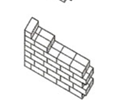
Match the brick masonry bond type in Group I with the corresponding illustration in Group II
Group I Group II (P) Rat Trap (1) 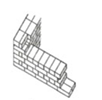
(Q) English (2) 
(R) Flemish (3) 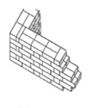
(S) Stretcher (4) 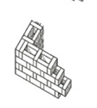
(5) 
- Cold joint' refers to the
- Match the Elements in Group - I with their Applications in Group - II
Group - I Group - II P Bracket 1 Door Q Baluster 2 Dome R Key stone 3 Cornice S Holdfast 4 Arch 5 Staircase - Match the Vibrator Types in Group-I with their related Areas of Application in Group-II
Group-I Group-II P Needle Vibrator 1 Concrete Pavement Q Shutter Vibrator 2 Pre-cast Concrete Unit R Surface Vibrator 3 Beam-Column Junction S Table Vibrator 4 Retaining Wall 5 Slip Forming - Match the type of Temporary Structures in Group - I with their corresponding Functions in Group - II
Group-I Group-II P Scaffolding 1 To support unsafe structure Q Formwork 2 To support platforms for workmen and materials at raised height during construction R Shoring 3 Removal of water from pits S Underpinning 4 Mould for RCC Structure 5 Strengthening the existing foundation


