Which point or region represents the Pull-out Torque in the shown torque-speed characteristic of a 3-phase induction motor? 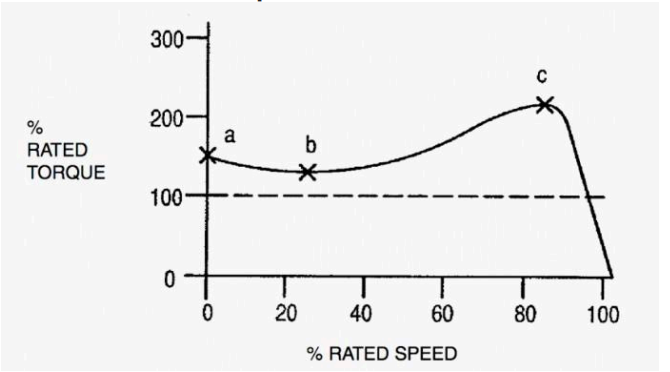
Point c
The torque-speed characteristic of a 3-phase induction motor typically shows how torque varies with speed. The Pull-out Torque, also known as the Breakdown Torque, indicates the maximum torque that the motor can develop without stalling.
In the provided torque-speed curve:
- Point a: This represents a point where torque begins to rise from starting conditions. It's not the maximum torque point.
- Point b: This point is generally where the motor could operate efficiently under normal conditions. It's not where the maximum torque occurs either.
- Point c: This is where the torque reaches its highest value, i.e., the maximum or Pull-out Torque, before decreasing as the speed approaches synchronous speed.
Based on the characteristic curve:
- Conclusion: Point c clearly represents the Pull-out Torque, as it is the peak point of the torque-speed curve, indicating the maximum torque the motor can develop before losing its capability to increase speed. Thus, the correct answer is Point c.
Similar Questions
Why does a squirrel cage induction motor not develop maximum starting torque?
Which set of statements correctly describes the steady state speed-torque characteristics of a three-phase synchronous motor?
i) Runs at constant synchronous speed
ii) Starting torque is zero
iii) Torque increases significantly with slip
iv) Not suitable for variable speed drives
v) Maintains speed under varying loads
The speed of a synchronous motor depends on:
When an alternator operates at unity power factor, the armature current:
Field failure protection in an alternator is provided to detect:
Important Questions from Alternator and Synchronous Motors
Consider the table given:
Constructional feature
Machine type
Mitigation
(P) Damper bars
(S) Induction motor
(X) Hunting
(Q) Skewed rotor slots
(T) Transformer
(Y) Magnetic locking
(R) Compensation winding
(U)Synchronous machine
(Z) Armature reaction
(V) DC machine
The correct combination that relates the constructional feature, machine type and mitigation isTorques are associated with synchronous motor; which of the following torques is also known as breakaway torque?
At unity power factor, armature reaction of an alternator is:
A three-phase synchronous motor will have:
Which of the following factors should be identical for two alternators running in parallel?