'P$Q' means ' P is to the north of Q'. 'P&Q' means 'P is to the east of Q'. 'P*Q' means 'Q is to the west of P'. 'P%Q' means 'Q is to the south of P'. 'P@QR' means 'P stands exactly in the middle of horizontal line QR'. 'P!QR' means 'P stands exactly in the middle of vertical line QR'. Note: 'P6m$Q' means 'P is 6 m to the north of Q' and so on. Find the shortest distance between G and C in the following expression. C12m$S5m*G3m&J6m%K!JT
13 m
Understanding Directional Relationships and Distances
This question involves analyzing coded directional relationships and distances between different points to find the shortest distance between two specific points, G and C.
Let's first understand the meaning of each symbol provided:
P$Q: P is to the north of Q.P&Q: P is to the east of Q.P*Q: Q is to the west of P (equivalent to P is to the east of Q).P%Q: Q is to the south of P (equivalent to P is to the north of Q).P@QR: P stands exactly in the middle of horizontal line QR.P!QR: P stands exactly in the middle of vertical line QR.
Note that distance is included, e.g., 'P6m$Q' means 'P is 6 m to the north of Q'.
Breaking Down the Expression: C12m$S5m*G3m&J6m%K!JT
We will analyze the given expression part by part:
C12m$S: C is 12m to the North of S.S5m*G: G is 5m to the West of S.G3m&J: G is 3m to the East of J.J6m%K: J is 6m to the North of K.K!JT: K is exactly in the middle of the vertical line JT.
Determining Relative Positions and Coordinates
Let's establish a coordinate system to represent the positions of the points. We can place S at the origin (0, 0) for simplicity.
- C12m$S: C is 12m North of S. If S is at (0, 0), C is at (0, 12).
- S5m*G: G is 5m West of S. If S is at (0, 0), G is at (-5, 0).
- G3m&J: G is 3m East of J. This means J is 3m West of G. Since G is at (-5, 0), J is at (-5 - 3, 0) = (-8, 0).
- J6m%K: J is 6m North of K. This means K is 6m South of J. Since J is at (-8, 0), K is at (-8, 0 - 6) = (-8, -6).
- K!JT: K is the midpoint of the vertical line JT. We know J is at (-8, 0) and K is at (-8, -6). Since K is the midpoint of JT and the line is vertical, T must be directly below K at the same horizontal position (-8). The distance JK is the difference in y-coordinates: $|0 - (-6)| = 6$m. Since K is the midpoint, the distance KT must also be 6m. T's y-coordinate will be K's y-coordinate minus 6. T is at (-8, -6 - 6) = (-8, -12).
Let's list the coordinates of the relevant points:
| Point | Coordinate (x, y) |
|---|---|
| C | (0, 12) |
| S | (0, 0) |
| G | (-5, 0) |
| J | (-8, 0) |
| K | (-8, -6) |
| T | (-8, -12) |
Calculating the Shortest Distance between G and C
We need to find the shortest distance between G and C. G is at (-5, 0) and C is at (0, 12). The shortest distance between two points in a coordinate plane is the straight line distance, which can be found using the Pythagorean theorem.
The difference in x-coordinates ($\Delta x$) is $|0 - (-5)| = 5$ m.
The difference in y-coordinates ($\Delta y$) is $|12 - 0| = 12$ m.
The shortest distance $d$ is given by the formula:
$$d = \sqrt{(\Delta x)^2 + (\Delta y)^2}$$
Substituting the values:
$$d = \sqrt{(5)^2 + (12)^2}$$
$$d = \sqrt{25 + 144}$$
$$d = \sqrt{169}$$
$$d = 13$$
The shortest distance between G and C is 13 m.
Final Answer
The shortest distance between G and C is 13 m.
Revision Table: Key Points
| Concept | Explanation | Application |
|---|---|---|
| Coded Directions | Symbols represent directions (North, East, West, South). | Translate $, &, *, %$ into directions. |
| Distances | Numbers with symbols indicate distance in meters. | Use distances with directions to plot points. |
| Midpoint Relation | @ for horizontal, ! for vertical midpoint. |
Used K!JT to find T's position based on J and K. |
| Shortest Distance | Straight line distance between two points. | Calculate using Pythagorean theorem on coordinate differences. |
| Coordinate System | Using (x, y) coordinates simplifies relative positioning. | Placing S at (0,0) helps determine other points' locations. |
Additional Information: Solving Directional Distance Puzzles
Directional distance reasoning questions test your ability to understand and apply directions and distances to determine relative positions. Here are some tips for solving such problems:
- Carefully read and understand the meaning of each symbol and notation used in the problem.
- Break down the given expression or statements into smaller, manageable parts.
- Visualize the movements and positions. Drawing a diagram or using a coordinate system can be extremely helpful.
- Pay attention to keywords like "North," "South," "East," "West," and "middle" or "midpoint."
- For shortest distance calculations between two points that are not on the same horizontal or vertical line, the Pythagorean theorem is typically used. Identify the horizontal and vertical differences between the two points.
- Ensure you calculate the distance between the correct points as asked in the question.
Practicing various types of directional distance problems will improve your speed and accuracy in solving them.
Important Questions from Coded direction and Distance
Ravi starts walking towards North. He turns to the right. Then he turns to the left. Hence he turns to the right at an angle of 45 degree. In which direction is he walking now?
Consider a location on the Earth where the Sun is overhead at noon. Compared to its shadow at 10.00 AM, the shadow of a tower at 4.00 PM would be
Read the information given below and answer the questions that follow by choosing the most appropriate option.
Manish is standing outside his office facing north. He walks 15 m to his right. Then, he truns to his left and walks for 23 m. Then, he turns to his right and walks fro 6 m. Then, he turns to his right and walks for 43 m to reach his home
What is the distance he will have to walk if he followed a straight-lined path from his office to his home?
Refer to the following number, symbol series and answer the question. Counting to be done from left to right only.
(Left) #1 * £ 3 & @ $ 8 $ 7 + 5 4 2 0 2 9 % (Right)
How many such symbols are there each of which is immediately preceded by a number and also immediately followed by another symbol?
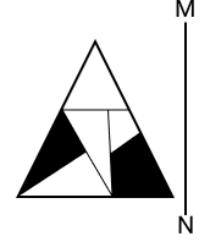
Select the correct mirror image of the given figure when the mirror is placed at MN as shown below.