
Read the information given below and answer the questions that follow by choosing the most appropriate option. Manish is standing outside his office facing north. He walks 15 m to his right. Then, he truns to his left and walks for 23 m. Then, he turns to his right and walks fro 6 m. Then, he turns to his right and walks for 43 m to reach his home What is the distance he will have to walk if he followed a straight-lined path from his office to his home?
29 m
To find the straight-line distance from Manish's office to his home, we need to determine his net displacement in the East-West and North-South directions. We can break down his movements step by step:
Step 1: Analyze Manish's Movements
- Manish starts at his office facing North.
- He walks 15 m to his right. Since he is facing North, his right is East. Movement: 15 m East.
- He turns to his left and walks 23 m. Facing East, turning left means he now faces North. Movement: 23 m North.
- He turns to his right and walks 6 m. Facing North, turning right means he now faces East. Movement: 6 m East.
- He turns to his right and walks 43 m. Facing East, turning right means he now faces South. Movement: 43 m South.
Step 2: Calculate Net Displacement
We calculate the total displacement along the East-West axis and the North-South axis separately.
East-West Displacement:
Manish moved East twice:
- First movement East = 15 m
- Second movement East = 6 m
- Total Eastward Displacement = $15 \text{ m} + 6 \text{ m} = 21 \text{ m}$
North-South Displacement:
Manish moved North once and South once:
- Movement North = 23 m
- Movement South = 43 m
- Net Southward Displacement = $43 \text{ m} - 23 \text{ m} = 20 \text{ m}$
- (This means he ended up 20 m South of his starting North-South position).
Step 3: Visualize the Final Position
Manish's final position is 21 m East and 20 m South relative to his starting point (office). This forms a right-angled triangle where:
- One leg is the net Eastward displacement (21 m).
- The other leg is the net Southward displacement (20 m).
- The hypotenuse is the straight-line distance from his office to his home.
Step 4: Calculate the Straight-Line Distance
We use the Pythagorean theorem to find the distance (hypotenuse):
Distance$^2$ = (Eastward Displacement)$^2$ + (Southward Displacement)$^2$
Distance$^2$ = $(21 \text{ m})^2 + (20 \text{ m})^2$
Distance$^2$ = $441 \text{ m}^2 + 400 \text{ m}^2$
Distance$^2$ = $841 \text{ m}^2$
Distance = $\sqrt{841 \text{ m}^2}$
Distance = $29 \text{ m}$
Conclusion
The straight-line distance Manish will have to walk from his office to his home is 29 m.
Important Questions from Coded direction and Distance
Ravi starts walking towards North. He turns to the right. Then he turns to the left. Hence he turns to the right at an angle of 45 degree. In which direction is he walking now?
Consider a location on the Earth where the Sun is overhead at noon. Compared to its shadow at 10.00 AM, the shadow of a tower at 4.00 PM would be
Refer to the following number, symbol series and answer the question. Counting to be done from left to right only.
(Left) #1 * £ 3 & @ $ 8 $ 7 + 5 4 2 0 2 9 % (Right)
How many such symbols are there each of which is immediately preceded by a number and also immediately followed by another symbol?
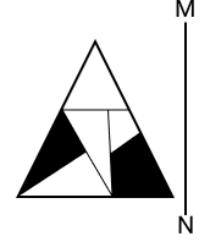
Select the correct mirror image of the given figure when the mirror is placed at MN as shown below.
AT 9 pm, the hour hand faces north, Which direction will the minute hand face at 6.30 am?


