
Consider a location on the Earth where the Sun is overhead at noon. Compared to its shadow at 10.00 AM, the shadow of a tower at 4.00 PM would be
three times longer
Shadow Length Calculation Explained
The length of a shadow cast by an object, like a tower, depends on the angle of elevation of the sun. When the sun is directly overhead (at its highest point), its angle of elevation is the maximum (90 degrees), and the shadow is shortest (ideally zero for a point source, but practically very short). As the sun moves lower in the sky towards sunrise or sunset, the angle of elevation decreases, and the shadow becomes longer.
The relationship between the height of the object (h), the length of the shadow (L), and the sun's angle of elevation ($\alpha$) is given by trigonometry:
$\tan(\alpha) = \frac{\text{height}}{\text{shadow length}} = \frac{h}{L}$
Rearranging this formula to find the shadow length:
$L = \frac{h}{\tan(\alpha)}$
The question states that the sun is overhead at noon at this location. This happens at a place on the Earth where the latitude is equal to the sun's declination angle. A common scenario where the sun is directly overhead (at the zenith, angle 90 degrees) at noon is at the equator during the time of the equinox (around March 20/21 and September 22/23), where both the latitude and the sun's declination are 0 degrees.
Let's assume this scenario: Latitude ($\phi$) = 0°, Sun's Declination ($\delta$) = 0°. The angle of elevation ($\alpha$) of the sun at a given hour angle ($h$) is approximately given by:
$\sin \alpha = \sin \phi \sin \delta + \cos \phi \cos \delta \cos h$
If $\phi = 0$ and $\delta = 0$, then $\sin 0 = 0$ and $\cos 0 = 1$. The formula simplifies to:
$\sin \alpha = 0 \times 0 + 1 \times 1 \times \cos h = \cos h$
The hour angle ($h$) is the angle through which the Earth has rotated since solar noon. It changes by 15 degrees every hour (360 degrees / 24 hours = 15 degrees/hour). Noon is at 12:00 PM, where the hour angle is 0 degrees.
Shadow Length at 10:00 AM
10:00 AM is 2 hours before noon (12:00 PM). So the hour angle is $2 \times 15^\circ = 30^\circ$ (West).
The sun's angle of elevation ($\alpha_{10}$) at 10:00 AM is found using $\sin \alpha_{10} = \cos 30^\circ$:
$\sin \alpha_{10} = \cos 30^\circ = \frac{\sqrt{3}}{2}$
$\alpha_{10} = \arcsin\left(\frac{\sqrt{3}}{2}\right) = 60^\circ$
The shadow length at 10:00 AM ($L_{10}$) is:
$L_{10} = \frac{h}{\tan(\alpha_{10})} = \frac{h}{\tan(60^\circ)} = \frac{h}{\sqrt{3}}$
Shadow Length at 4:00 PM
4:00 PM is 4 hours after noon (12:00 PM). So the hour angle is $4 \times 15^\circ = 60^\circ$ (East).
The sun's angle of elevation ($\alpha_4$) at 4:00 PM is found using $\sin \alpha_4 = \cos 60^\circ$:
$\sin \alpha_4 = \cos 60^\circ = \frac{1}{2}$
$\alpha_4 = \arcsin\left(\frac{1}{2}\right) = 30^\circ$
The shadow length at 4:00 PM ($L_4$) is:
$L_4 = \frac{h}{\tan(\alpha_4)} = \frac{h}{\tan(30^\circ)} = \frac{h}{1/\sqrt{3}} = h\sqrt{3}$
Comparing Shadow Lengths
To compare the shadow at 4:00 PM to the shadow at 10:00 AM, we find the ratio $L_4 / L_{10}$:
$\frac{L_4}{L_{10}} = \frac{h\sqrt{3}}{\frac{h}{\sqrt{3}}} = h\sqrt{3} \times \frac{\sqrt{3}}{h} = \sqrt{3} \times \sqrt{3} = 3$
This shows that the shadow length at 4:00 PM is 3 times the shadow length at 10:00 AM under these conditions.
| Time | Hours from Noon | Hour Angle ($h$) | Sun Angle ($\alpha$) | Shadow Length ($L$) |
|---|---|---|---|---|
| 10:00 AM | 2 hours before | $30^\circ$ | $\arcsin(\cos 30^\circ) = 60^\circ$ | $h / \tan(60^\circ) = h/\sqrt{3}$ |
| 4:00 PM | 4 hours after | $60^\circ$ | $\arcsin(\cos 60^\circ) = 30^\circ$ | $h / \tan(30^\circ) = h\sqrt{3}$ |
The comparison confirms that the shadow at 4:00 PM is three times longer than the shadow at 10:00 AM, based on the assumption of being at the equator during an equinox where the sun is overhead at noon.
Important Questions from Coded direction and Distance
Ravi starts walking towards North. He turns to the right. Then he turns to the left. Hence he turns to the right at an angle of 45 degree. In which direction is he walking now?
Read the information given below and answer the questions that follow by choosing the most appropriate option.
Manish is standing outside his office facing north. He walks 15 m to his right. Then, he truns to his left and walks for 23 m. Then, he turns to his right and walks fro 6 m. Then, he turns to his right and walks for 43 m to reach his home
What is the distance he will have to walk if he followed a straight-lined path from his office to his home?
Refer to the following number, symbol series and answer the question. Counting to be done from left to right only.
(Left) #1 * £ 3 & @ $ 8 $ 7 + 5 4 2 0 2 9 % (Right)
How many such symbols are there each of which is immediately preceded by a number and also immediately followed by another symbol?
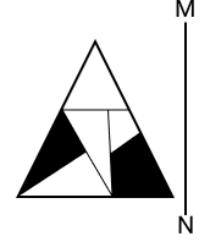
Select the correct mirror image of the given figure when the mirror is placed at MN as shown below.
AT 9 pm, the hour hand faces north, Which direction will the minute hand face at 6.30 am?


