
On the basis of dip isogons describe the classification of folds with neat diagrams.
Classification of Folds Based on Dip Isogons
Folds are fundamental structures in structural geology, resulting from the ductile deformation of rock layers. Their classification based on dip isogons provides a detailed and quantitative method to understand their geometry and kinematic evolution. Dip isogons are lines connecting points of equal dip on the upper and lower boundaries of a folded layer. Their behavior throughout a fold allows for a rigorous classification.
Dip Isogons
A dip isogon is a line that joins points of equal dip (slope) on the inner and outer boundaries of a folded layer. By observing the convergence, divergence, or parallelism of these isogons, geologists can classify folds into distinct categories, which in turn reflect the deformation mechanisms at play.
Classification of Folds
Based on the behavior of dip isogons, folds are classified into three main classes, with further subdivisions:
- Class 1 Folds (Convergent Isogons)
In Class 1 folds, the dip isogons converge towards the inner arc of the fold. This indicates that the layer thickness, measured perpendicular to the bedding (true thickness), decreases from the hinge to the limbs. This class is further subdivided based on the degree of convergence.
Mechanism: Typically formed by ductile flow or passive folding where material moves from the limbs to the hinge zone, or by flexural slip with significant layer-parallel shortening in the hinge.
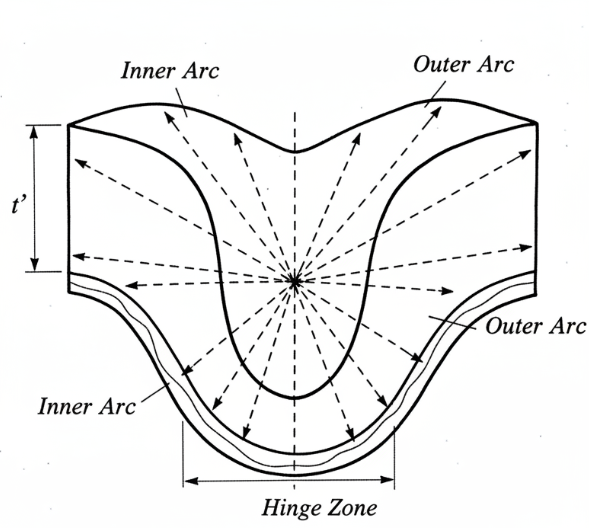
- Class 2 Folds (Parallel Isogons - Similar Folds)
In Class 2 folds, the dip isogons are parallel to the axial plane of the fold. This implies that the layer thickness, measured parallel to the axial plane (axial plane thickness), remains constant around the fold. True thickness, however, varies significantly, being thickest at the hinge and thinnest at the limbs.
Mechanism: Formed by passive flow or shear folding, where deformation occurs through homogeneous simple shear or flow of material within the layers. This is common in highly ductile rocks or at high temperatures and pressures.
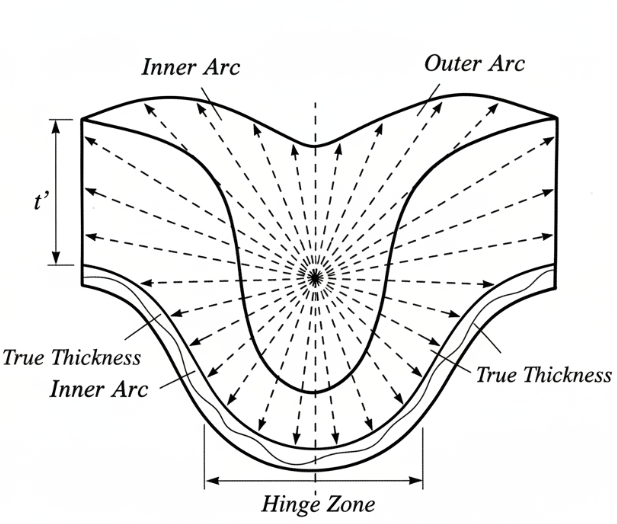
- Class 3 Folds (Divergent Isogons)
In Class 3 folds, the dip isogons diverge towards the inner arc (or converge towards the outer arc). This signifies that the true thickness of the layer increases from the hinge to the limbs. The curvature of the outer arc is greater than that of the inner arc.
Mechanism: Can be associated with complex rheological behaviors or specific strain distributions where limb thickening occurs.
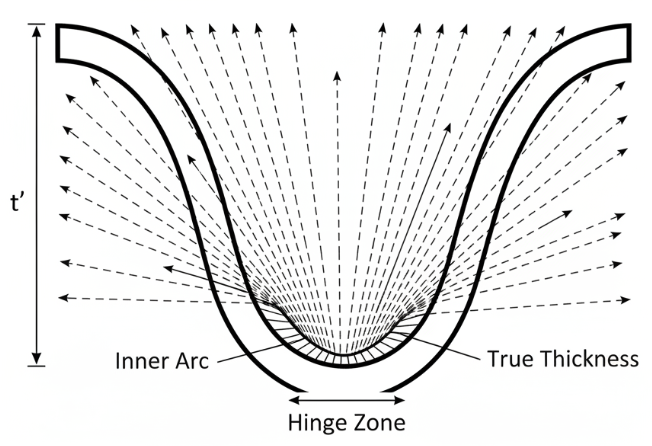
Answered By:
Harsh Raj
Harsh Raj is a successful government exam expert, having cleared multiple stages of SSC CGL, IBPS PO, CDS, RRB NTPC, and Delhi Police SI exams himself and mentored more than 5000 students through direct mentorship. His expertise is in creating well researched content, especially MCQs, which have been directly asked by relevant commissions in multiple exams.

Similar Questions
Discuss the position of Asteroid belt within the solar system and comment on the composition of meteorites.
What are sheath folds? Discuss the deformational conditions of their formation.
What is Global Positioning System (GPS)? Explain its geological applications.
Discuss the statement giving suitable examples. "Physical weathering adds to the effectiveness of Chemical weathering".
Discuss the types of Penetrative and Non-penetrative lineations with the help of suitable diagrams and throw light on their genesis.
Discuss favourable conditions for fossilization.
Discuss different concepts of biozonation with neat diagrams.
Describe the lithology, type locality, age and depositional environment of Blaini Boulder Bed.
What engineering properties make Marble, Sandstone and Granite useful as building stone?
Explain different generic type of water and their significance in water supply.
Important Questions from Miscellaneous
How will you manage a case of misplaced copper-T (Cu-T)?
Describe the embryogenesis, clinical features and principles of management of cleft palate.
Write short notes in 150 words:
MetagenesisWrite short notes in 150 words:
Book lungsWrite short notes in 150 words:
Paedomorphosis



