
Question
Match the LIST-I with LIST-II A. B. C. D.
LIST-I
Sampling frame
(Circles denotes unit selected)LIST-II
Sampling Procedure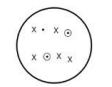
I. Systematic Sampling 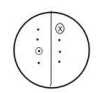
II. Cluster Sampling 
III. Simple Random Sampling 
IV. Stratified Random Sampling
Choose the correct answer from the options given below:
The correct answer is
A-III, B-IV, C-I, D-II
To solve this question, we need to match the images representing different sampling frames (List-I) with the corresponding sampling procedures (List-II).
- Simple Random Sampling: This is a method where each unit of the population has an equal chance of being selected. Typically, units are selected randomly without any specific pattern.
The image labeled as A is a disperse distribution of selected units, which is characteristic of simple random sampling. - Stratified Random Sampling: In this method, the population is divided into subgroups (strata), and random samples are taken from each stratum.
The image labeled as B shows units divided into separate sections, indicating a stratified random sampling process. - Systematic Sampling: In this method, after selecting a random start, every nth unit is selected from the list.
The image labeled as C shows a pattern of selecting units at regular intervals, which is typical of systematic sampling. - Cluster Sampling: Here, the population is divided into clusters, and entire clusters are randomly selected.
The image labeled as D shows selections concentrated within a specific area, characteristic of cluster sampling.
Based on the descriptions and matches, the correct option is:
A-III (Simple Random Sampling), B-IV (Stratified Random Sampling), C-I (Systematic Sampling), D-II (Cluster Sampling)
Was this answer helpful?
Important Questions from Sampling Techniques - Teaching
Homogenous subsets in the sampling are called
- To select an unbiased sample in statistical sense we need to make sure each unit has an ______ and ______ chance of selection.
- Theoretical sampling is used when.
A. Extension of the basic population is not known in advance
B. Features of the basic population are not known in advance
C. Sample Size is not defined in advance
D. Repeated drawing of sampling elements with criteria to be defined again in each step
E. Sampling is finished when the whole sample has been studied
Choose the correct answer from the options given below: - Which of the following is not a non-probability method of selecting samples from a population?
- The sampling frame from which sample is to be drawn is known as _________
Need Expert Advice?


