
List-I List-II (A) Tollen's reagent (I) Rochelle salt (B) Jones reagent (II) Conc. HCl and $ZnCl_2$ (C) Lucas reagent (III) Ammoniacal silver nitrate (D) Fehling solution (IV) Chromium trioxide-sulphuric acid
Choose the correct answer from the options given below :
Matching Chemical Reagents: A Step-by-Step Guide
This question requires matching common chemical reagents with their constituents or associated names. Let's break down each reagent:
Tollen's Reagent
Tollen's reagent, also known as the ammoniacal silver nitrate solution, is used for the qualitative detection of aldehydes. It is prepared by adding sodium hydroxide to silver nitrate solution, followed by the addition of ammonia solution until the precipitate of silver oxide just dissolves.
- Match: (A) - (III) Ammoniacal silver nitrate
Jones Reagent
Jones reagent is a solution of chromium trioxide ($CrO_3$) in dilute sulfuric acid ($H_2SO_4$). It is a strong oxidizing agent used in organic chemistry, primarily for oxidizing primary alcohols to carboxylic acids and secondary alcohols to ketones.
- Match: (B) - (IV) Chromium trioxide-sulphuric acid
Lucas Reagent
The Lucas reagent is used to distinguish between primary, secondary, and tertiary alcohols. It is a solution of anhydrous zinc chloride ($ZnCl_2$) in concentrated hydrochloric acid (Conc. HCl).
- Match: (C) - (II) Conc. HCl and $ZnCl_2$
Fehling Solution
Fehling solution consists of two mixtures, Fehling's solution A and Fehling's solution B. Fehling's solution B is an alkaline solution of potassium sodium tartrate, commonly known as Rochelle salt. It is used to detect the presence of aldehydes.
- Match: (D) - (I) Rochelle salt
Correct Matching Summary
Based on the analysis, the correct matches are:
- (A) - (III)
- (B) - (IV)
- (C) - (II)
- (D) - (I)
This corresponds to the first option provided.
Important Questions from Aldehydes, Ketones and Carboxylic Acids
Phenol is brominated in solvent CS₂ at low temperature. The product formed are:
What is not true regarding compound [B]?
(A) They are higher boiling liquids than aldehydes and ketones due to extensive H bonding
(B) They are soluble in Benzene
(C) They produce alkane when heated with soda lime
(D) Produces CO₂ when treated with NaHCO₃
Choose the correct answer from the options given below:
Which of the following is the correct statement for hybridization of C-atom and number of π bonds in the Carbonyl group?
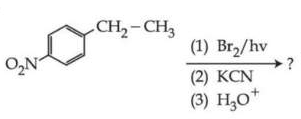
What is the product formed in the following reaction sequence?
What will be the product formed when cyclohexanone undergoes Aldol condensation?


