Match List-I with List-II: Choose the correct answer from the options given below:List-I List-II (A) Electric field outside a uniformly charged thin spherical shell (IV) \( k \frac{q}{r^2} \hat{r} \) (B) Electric field inside the uniformly charged thin spherical shell (I) Zero (C) Electric field due to an infinitely long straight uniformly charged wire (II) \( \frac{\lambda}{2\pi\epsilon_0 r} \hat{n} \) (D) Electric field due to a uniformly charged infinite plane sheet (III) \( \frac{\sigma}{2\epsilon_0} \hat{n} \)
(A)-(IV), (B)-(I), (C)-(II), (D)-(III)
Matching Electric Field Formulas with Charge Distributions
This question asks us to match different charge distributions with the formulas for the electric field they produce. We need to recall or derive the electric field equations for each case listed using principles like Gauss's Law.
Analyzing Each Charge Distribution and Electric Field
Let's analyze each item in List-I and find its corresponding electric field formula in List-II.
(A) Electric field outside a uniformly charged thin spherical shell
For a uniformly charged thin spherical shell with total charge \(q\) and radius \(R\), at a point outside the shell (distance \(r > R\) from the center), the electric field is the same as that of a point charge \(q\) located at the center. This is a direct application of Gauss's Law due to spherical symmetry. The formula for the electric field magnitude is:
\( E = \frac{1}{4\pi\epsilon_0} \frac{q}{r^2} \)
In vector form, with \(\hat{r}\) being the unit vector radially outward from the center, the electric field is:
\( \vec{E} = \frac{1}{4\pi\epsilon_0} \frac{q}{r^2} \hat{r} \)
Using the constant \(k = \frac{1}{4\pi\epsilon_0}\), this becomes:
\( \vec{E} = k \frac{q}{r^2} \hat{r} \)
This matches option (IV) in List-II.
Therefore, (A) matches (IV).
(B) Electric field inside the uniformly charged thin spherical shell
For a uniformly charged thin spherical shell, at any point inside the shell (distance \(r < R\) from the center), the electric field is zero. This can also be shown using Gauss's Law; a Gaussian surface inside the shell encloses no charge, so the electric flux is zero, implying the electric field is zero.
\( \vec{E}_{inside} = \vec{0} \)
This matches option (I) in List-II.
Therefore, (B) matches (I).
(C) Electric field due to an infinitely long straight uniformly charged wire
For an infinitely long straight wire with uniform linear charge density \(\lambda\), the electric field at a distance \(r\) from the wire is radially outward (if \(\lambda > 0\)) and its magnitude is given by:
\( E = \frac{\lambda}{2\pi\epsilon_0 r} \)
In vector form, with \(\hat{n}\) being the unit vector radially outward from the wire, the electric field is:
\( \vec{E} = \frac{\lambda}{2\pi\epsilon_0 r} \hat{n} \)
This matches option (II) in List-II.
Therefore, (C) matches (II).
(D) Electric field due to a uniformly charged infinite plane sheet
For a uniformly charged infinite plane sheet with uniform surface charge density \(\sigma\), the electric field is uniform and perpendicular to the plane. Its magnitude is given by:
\( E = \frac{\sigma}{2\epsilon_0} \)
The field points away from the plane if \(\sigma > 0\) and towards the plane if \(\sigma < 0\). In vector form, with \(\hat{n}\) being the unit vector perpendicular to the plane, the electric field is:
\( \vec{E} = \frac{\sigma}{2\epsilon_0} \hat{n} \)
This matches option (III) in List-II.
Therefore, (D) matches (III).
Summary of Matches
Based on the analysis, the correct matches are:
- (A) - (IV)
- (B) - (I)
- (C) - (II)
- (D) - (III)
Let's check the given options against these matches.
| List-I (Charge Distribution) | Matching List-II (Electric Field) |
|---|---|
| (A) Electric field outside a uniformly charged thin spherical shell | (IV) \( k \frac{q}{r^2} \hat{r} \) |
| (B) Electric field inside the uniformly charged thin spherical shell | (I) Zero |
| (C) Electric field due to an infinitely long straight uniformly charged wire | (II) \( \frac{\lambda}{2\pi\epsilon_0 r} \hat{n} \) |
| (D) Electric field due to a uniformly charged infinite plane sheet | (III) \( \frac{\sigma}{2\epsilon_0} \hat{n} \) |
Comparing this with the options, Option 1 lists these exact matches: (A)-(IV), (B)-(I), (C)-(II), (D)-(III).
Conclusion
The correct matching is (A)-(IV), (B)-(I), (C)-(II), (D)-(III).
Revision Table: Electric Fields and Charge Distributions
| Charge Distribution | Electric Field Formula (\( \vec{E} \)) | Notes |
|---|---|---|
| Point Charge \(q\) | \( k \frac{q}{r^2} \hat{r} \) | \( \hat{r} \) is radial unit vector |
| Uniformly Charged Thin Spherical Shell (outside, \(r > R\)) | \( k \frac{q}{r^2} \hat{r} \) | \(q\) is total charge, same as point charge |
| Uniformly Charged Thin Spherical Shell (inside, \(r < R\)) | \( \vec{0} \) | Field is zero inside the shell |
| Infinitely Long Uniformly Charged Wire (linear density \( \lambda \)) | \( \frac{\lambda}{2\pi\epsilon_0 r} \hat{n} \) | \(r\) is distance from wire, \( \hat{n} \) is radial unit vector from wire |
| Uniformly Charged Infinite Plane Sheet (surface density \( \sigma \)) | \( \frac{\sigma}{2\epsilon_0} \hat{n} \) | \( \hat{n} \) is unit vector perpendicular to plane |
Additional Information on Electric Fields and Gauss's Law
The formulas for the electric field of these different charge distributions are typically derived using Gauss's Law, which is a fundamental law in electromagnetism. Gauss's Law relates the electric flux through a closed surface to the net electric charge enclosed within that surface.
The mathematical statement of Gauss's Law is:
\( \oint_S \vec{E} \cdot d\vec{A} = \frac{Q_{enclosed}}{\epsilon_0} \)
Where:
- \( \oint_S \vec{E} \cdot d\vec{A} \) is the electric flux through the closed surface \(S\).
- \( \vec{E} \) is the electric field.
- \( d\vec{A} \) is a differential area vector element of the surface.
- \( Q_{enclosed} \) is the total charge enclosed within the surface \(S\).
- \( \epsilon_0 \) is the permittivity of free space.
Gauss's Law is particularly useful for calculating electric fields when the charge distribution has high symmetry (spherical, cylindrical, or planar symmetry), as seen in the examples in this question.
Important Questions from Electric Charges and Fields
Two charged particles, placed at a distance d apart in vacuum, exert a force F on each other. Now, each of the charges is doubled. To keep the force unchanged, the distance between the charges should be changed to:
When a slab of insulating material 4 mm thick is introduced between the plates of a parallel plate capacitor of separation 4 mm, it is found that the distance between the plates has to be increased by 3.2 mm to restore the capacity to its original value. The dielectric constant of the material is:
Match List - I with List - II.
List - I List - II (A) Electric Field (I) [LTA] (B) Electric Flux (II) [L2] (C) Electric Dipole Moment (III) [ML3T−3A−1] (D) Area Vector Element (IV) [MLT−3A−1] Choose the correct answer from the options given below:
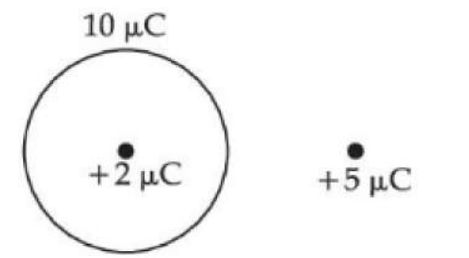
A thin metallic spherical shell contains a charge +10 μC on it. A point charge +2 μC is placed at the centre of the shell and another charge +5 μC is placed outside it as shown. The force on the charge +2 μC at the centre is:
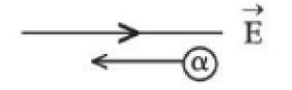
In the figure, an α-particle moves a distance l in a uniform electric field E as shown. Does the Electric Field do a positive or a negative work on the α-particle? Does the electric potential energy of the α-particle increase or decrease?