I II A The peeling away of layers or sheets of rock Q Exhumation B The interface between weathered material and unweathered bed rock R Exfoliation C The uncovering of surfaces beneath regolith or younger geological material S Pseudokarst D Dark staining of rock surface in arid regions T Rock varnish U Weathering front
Matching Rock Weathering and Geological Terms
This question requires matching geological terms from Column I with their definitions in Column II. Let's analyze each item:
- A: The peeling away of layers or sheets of rock
This process, where layers of rock detach like an onion's skin, is known as Exfoliation. It is a common form of weathering caused by pressure release or thermal expansion and contraction. This matches term R. - B: The interface between weathered material and unweathered bed rock
This boundary defines the depth to which weathering has progressed into the solid rock. It is referred to as the Weathering front. This matches term U. - C: The uncovering of surfaces beneath regolith or younger geological material
This describes the process where buried rocks or surfaces are exposed due to erosion or uplift. This is the definition of Exhumation. This matches term Q. - D: Dark staining of rock surface in arid regions
The dark coating often found on rocks in dry environments, formed by mineral and potentially microbial activity, is called Rock varnish. This matches term T.
Final Match
Based on the analysis:
- A matches R (Exfoliation)
- B matches U (Weathering front)
- C matches Q (Exhumation)
- D matches T (Rock varnish)
Therefore, the correct combination is A - R, B - U, C - Q, D - T.
Important Questions from Weathering
- Bauxite formation is an example of metal enrichment by extreme
- Silcretes or silica-rich duricrusts generally form under
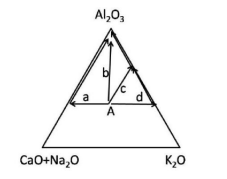
During normal weathering of a granite rock (A), clay minerals and then residue of gibbsite are formed. Which one is the correct weathering path for the rock in the given diagram ($\text{Al}_2\text{O}_3$, $\text{CaO}$, $\text{Na}_2\text{O}$ and $\text{K}_2\text{O}$ are in moles).
- During spheroidal weathering, a block of rock converts to a spheroid due to
- Which type(s) of chemical reactions occur(s) during the weathering of pyroxene?