
Question
During spheroidal weathering, a block of rock converts to a spheroid due to
The correct answer is
rapid chemical weathering at the corners than at the smooth faces
Spheroidal Weathering: Key Processes Explained
Spheroidal weathering is a type of chemical weathering that affects rocks, particularly those with interlocking joints. It results in the rounding of rock blocks.
Mechanism of Spheroidal Weathering
- Rocks often have cracks or joints that divide them into blocks.
- Weathering agents, mainly water containing dissolved acids, attack the rock surface.
- Corners and edges of a rock block have more exposed surface area than the flat faces.
- Chemical weathering processes are significantly more effective at these corners and edges compared to the relatively smoother faces.
- This differential weathering rate, where corners erode faster due to enhanced chemical attack, gradually transforms the angular block into a rounded or spheroidal shape.
Analysis of Options
- Option 1: Incorrect. While physical weathering occurs, the rounding process specific to spheroidal weathering is dominated by chemical reactions.
- Option 2: Correct. The accelerated rate of chemical weathering at the corners and edges is the primary reason for the formation of spheroids.
- Option 3: Incorrect. Spheroidal weathering relies on *unequal* rates of weathering (differential weathering), not equal rates.
- Option 4: Incorrect. Spheroidal weathering is a process occurring *in situ* (in its original place) due to weathering, not a result of physical breakage during transport.
Therefore, the conversion of a rock block to a spheroid during spheroidal weathering is due to rapid chemical weathering at the corners compared to the faces.
Was this answer helpful?
Important Questions from Weathering
- Bauxite formation is an example of metal enrichment by extreme
- Silcretes or silica-rich duricrusts generally form under
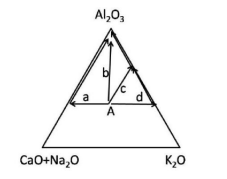
During normal weathering of a granite rock (A), clay minerals and then residue of gibbsite are formed. Which one is the correct weathering path for the rock in the given diagram ($\text{Al}_2\text{O}_3$, $\text{CaO}$, $\text{Na}_2\text{O}$ and $\text{K}_2\text{O}$ are in moles).
- Which type(s) of chemical reactions occur(s) during the weathering of pyroxene?
- Which one of the following is NOT a common set of secondary minerals formed by weathering?
Need Expert Advice?


