
Pyroxene Weathering: Chemical Reactions
The weathering of pyroxene, a common group of silicate minerals, involves several chemical processes. Understanding these reactions is key to explaining mineral decomposition in geological settings.
Hydrolysis in Pyroxene Weathering
Hydrolysis is a significant chemical weathering process where water molecules react with and break down minerals. In pyroxenes, water attacks the silicon-oxygen bonds and cations (like magnesium and iron) within the mineral structure. This process often leads to the formation of secondary minerals like clays.
Oxidation in Pyroxene Weathering
Oxidation occurs when minerals react with oxygen, typically in the presence of water. Pyroxenes often contain iron (Fe2+). During oxidation, Fe2+ is converted to Fe3+, forming iron oxides and hydroxides (like hematite or goethite). This reaction changes the mineral's structure and color, often making it appear redder or browner.
Combined Reactions
Pyroxene weathering commonly involves both hydrolysis and oxidation acting simultaneously or sequentially:
- Hydrolysis: Breaks down the silicate framework and releases cations.
- Oxidation: Alters the oxidation state of iron (Fe2+ to Fe3+), leading to the formation of iron oxides/hydroxides.
Because pyroxene minerals frequently contain iron and are susceptible to water interaction, both hydrolysis and oxidation are crucial chemical reactions occurring during their weathering.
Important Questions from Weathering
- Bauxite formation is an example of metal enrichment by extreme
- Silcretes or silica-rich duricrusts generally form under
During normal weathering of a granite rock (A), clay minerals and then residue of gibbsite are formed. Which one is the correct weathering path for the rock in the given diagram ($\text{Al}_2\text{O}_3$, $\text{CaO}$, $\text{Na}_2\text{O}$ and $\text{K}_2\text{O}$ are in moles).
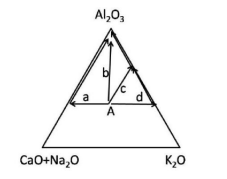
- During spheroidal weathering, a block of rock converts to a spheroid due to
- Which one of the following is NOT a common set of secondary minerals formed by weathering?


