
Bauxite Formation: Understanding Metal Enrichment
Bauxite formation is a prime example of how geological processes concentrate metals. The enrichment of aluminum in bauxite ores occurs through intense weathering of aluminum-rich rocks.
Role of Chemical Leaching
The primary process responsible for this enrichment is chemical leaching. This occurs under specific climatic conditions, typically tropical or subtropical, characterized by high rainfall and temperatures.
- Rainwater, slightly acidic from dissolved carbon dioxide, percolates through the parent rock.
- This acidic water dissolves and removes more soluble elements like silica (SiO2), iron (Fe), alkali metals (Na, K), and alkaline earth metals (Ca, Mg).
- The less soluble elements, primarily aluminum oxides and hydroxides (like gibbsite, boehmite, and diaspore), remain behind.
- This residual accumulation leads to a significant increase, or enrichment, in the concentration of aluminum, forming bauxite deposits.
Why Other Options Are Incorrect
- Crystal fractionation: This process involves the separation of minerals from a melt (like magma) based on differing crystallization temperatures. It's crucial in igneous petrology but not the primary mechanism for bauxite formation.
- Mechanical concentration: This involves physical processes like erosion and deposition, where minerals are separated based on physical properties like density or size (e.g., placer deposits). Bauxite formation is a chemical process.
- Gravity separation: This is a subset of mechanical concentration, relying specifically on density differences to separate materials. It does not apply to the chemical dissolution and residual enrichment seen in bauxite formation.
Therefore, the metal enrichment in bauxite formation is best described as a result of extreme chemical leaching.
Important Questions from Weathering
- Silcretes or silica-rich duricrusts generally form under
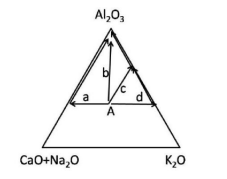
During normal weathering of a granite rock (A), clay minerals and then residue of gibbsite are formed. Which one is the correct weathering path for the rock in the given diagram ($\text{Al}_2\text{O}_3$, $\text{CaO}$, $\text{Na}_2\text{O}$ and $\text{K}_2\text{O}$ are in moles).
- During spheroidal weathering, a block of rock converts to a spheroid due to
- Which type(s) of chemical reactions occur(s) during the weathering of pyroxene?
- Which one of the following is NOT a common set of secondary minerals formed by weathering?


