
Secondary Minerals Formation by Weathering
Secondary minerals are formed from the alteration or decomposition of existing (primary) minerals, a process commonly driven by weathering. Understanding which minerals are typical weathering products helps identify sets that deviate from this pattern.
Common Weathering Products
Several minerals listed are frequently observed results of rock and mineral weathering:
- Hematite ($\text{Fe}_2\text{O}_3$) and Goethite ($\text{FeO(OH)}$): These iron oxides/oxyhydroxides commonly form from the oxidation and hydration of iron-bearing primary minerals (like micas and pyroxenes).
- Gibbsite ($\text{Al(OH)}_3$): This aluminum hydroxide is a common end-product of intense weathering of aluminum-silicate minerals, especially in tropical and subtropical regions.
- Kaolinite ($\text{Al}_2\text{Si}_2\text{O}_5\text{(OH)}_4$): This clay mineral is a typical product of hydrolysis weathering of feldspars and other silicate minerals.
Identifying the Non-Weathering Set
The question asks for the set that is NOT a common suite of secondary minerals formed by weathering. While Hematite, Goethite, Gibbsite, and Kaolinite are widely recognized weathering products:
- Gypsum ($\text{CaSO}_4 \cdot 2\text{H}_2\text{O}$) is a notable exception in this context. While it can form through secondary processes (like evaporation in arid environments or dissolution/precipitation involving sulfates), it is not as universally considered a direct, common end-product of the typical silicate weathering that produces the other minerals listed. Its formation is often linked to specific evaporite conditions or dissolution of sulfate sources rather than the breakdown of common silicate minerals in many weathering environments.
Therefore, the set including Goethite, Gibbsite, and Gypsum is the one that does not represent a common combination of minerals exclusively formed by typical weathering processes.
Important Questions from Weathering
- Bauxite formation is an example of metal enrichment by extreme
- Silcretes or silica-rich duricrusts generally form under
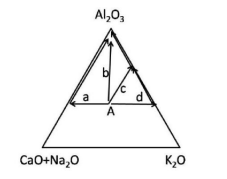
During normal weathering of a granite rock (A), clay minerals and then residue of gibbsite are formed. Which one is the correct weathering path for the rock in the given diagram ($\text{Al}_2\text{O}_3$, $\text{CaO}$, $\text{Na}_2\text{O}$ and $\text{K}_2\text{O}$ are in moles).
- During spheroidal weathering, a block of rock converts to a spheroid due to
- Which type(s) of chemical reactions occur(s) during the weathering of pyroxene?


