Crank-Rod Ratio Increase Effects
This analysis explains how altering the ratio between the crank length ($L_c$) and the connecting rod length ($L_r$) affects sley eccentricity.
Ratio Definition and Implications
The critical ratio is $\frac{L_c}{L_r}$. When this ratio increases, it signifies that the crank length is becoming relatively larger compared to the connecting rod length.
Motion Asymmetry in Mechanisms
In mechanisms like those found in looms, the ratio $\frac{L_c}{L_r}$ dictates the nature of motion. An increased ratio leads to:
- A relatively shorter connecting rod effect.
- The resulting motion deviates significantly from a simple harmonic (sinusoidal) path.
- Increased asymmetry in the motion cycle.
Sley Eccentricity Outcome
This pronounced asymmetry in the mechanism's movement is directly related to sley eccentricity. Consequently, a higher crank-to-connecting rod length ratio results in increased sley eccentricity.
Important Questions from FABR Loom Mechanisms Beating-up
- Amongst the following, producing a dense fabric in a weaving machine require(s)
Two shuttle looms (A and B), running at same picks per minute, have same mass of sley and associated system for beat up. The crank radius ($r$) and the eccentricity ratio ($e$) of the looms are
$r_A = 10 \text{ cm}; e_A = 0.5; r_B = 6 \text{ cm}; e_B = 0.4$
The ratio of the beat up force of loom A to that of loom B (rounded off to 1 decimal place) is ________- At front centre ($0^\circ$) and at back centre ($180^\circ$) of a shuttle loom,
- The force exerted by the reed on the cloth-fell at the instant of beat-up (weaving resistance) depends on
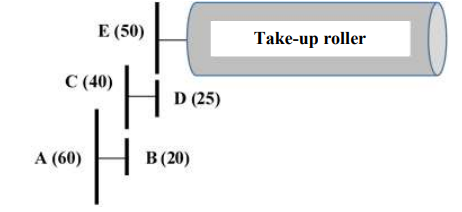
A take-up motion is shown below. The number of teeth on gear A, B, C, D and E are 60, 20, 40, 25 and 50, respectively. The circumference of the take-up roller is 40 cm. If one tooth is broken on gear B, then the wavelength (cm) of the fault in fabric (in integer) is _________________.