
In the given block diagram of the PLL circuit, the input reference frequency $f_{in} = 40 \ MHZ$. What is the value of output frequency $f_{out}$ when the PLL is operating in locked state?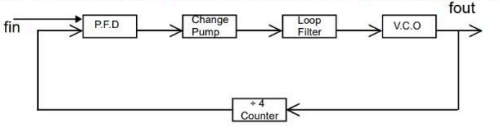
In a Phase-Locked Loop (PLL) circuit, the output frequency \(f_{\text{out}}\) is determined by the input reference frequency \(f_{\text{in}}\) and the division factor of the counter in the feedback path.
Given:
- Input reference frequency, \(f_{\text{in}} = 40 \ \text{MHz}\)
- The feedback path includes a counter with a division factor of 4.
When the PLL is locked, the output frequency \(f_{\text{out}}\) can be derived using the formula:
\(f_{\text{out}} = N \times f_{\text{in}}\)
Where \(N\) is the division factor. Here, \(N = 4\), as given by the counter.
Therefore, the output frequency is calculated as:
\(\begin{align*} f_{\text{out}} &= 4 \times 40 \ \text{MHz} \\ &= 160 \ \text{MHz} \end{align*}\)
Thus, the value of the output frequency when the PLL is in a locked state is \(160 \ \text{MHz}\).
The correct answer is:
$160 \ MHZ$
Important Questions from Closed Loop Control Systems
Which of the following statements about the closed-loop control system compared to open-loop control system is INCORRECT?
Using negative feedback for improvements, which statement is false
Open loop transfer function of a closed loop control system is defined as:
The impulse response of the transfer function 1 is
Consider the following statements:
A. The effect of feedback is to reduce the system error.
B. Feedback increases the gain of the system is one frequency range but decreases in another.
C. Feedback can cause a system that is originally stable to become unstable.
Which of these statements are correct?


