
In the following statements:
A. If $g(t) \rightleftharpoons G(f)$, then $G(t) \rightleftharpoons g(-f)$ is duality property
B. Mixer is not the basic element of superhtrodyane AM receiver
C. The power spectral density of a wide sense stationary random process is always Negative
D. Typical RF carrier range for FM radio is 88-108GHz
E. Typical RF carrier range for AM radio is 0.535-1.605 MHz
Choose the correct answer from the options given below:
Evaluating Signal Processing Statements
This question requires evaluating five statements related to signal processing and radio communication to determine which ones are accurate.
Statement Analysis
Statement A: Duality Property
The statement claims that if a function $g(t)$ and its Fourier Transform $G(f)$ are related by $g(t) \rightleftharpoons G(f)$, then the relationship $G(t) \rightleftharpoons g(-f)$ represents the duality property.
Explanation: The Fourier Transform duality property indeed states that if the Fourier Transform of a function $x(t)$ is $X(f)$ (denoted as $x(t) \leftrightarrow X(f)$), then the Fourier Transform of $X(t)$ is $x(-f)$ (i.e., $X(t) \leftrightarrow x(-f)$). Applying this to the given function $g(t)$ and its transform $G(f)$, the property holds true. Therefore, Statement A is Correct.
Statement B: Mixer in Superheterodyne Receiver
This statement asserts that a mixer is not a fundamental component of a superheterodyne AM receiver.
Explanation: The superheterodyne receiver architecture relies heavily on the mixer. Its primary function is to down-convert the incoming radio frequency (RF) signal to a fixed intermediate frequency (IF) by beating it with a signal from a local oscillator. This process is essential for the receiver's operation. Hence, the mixer is a basic and critical element. Therefore, Statement B is Incorrect.
Statement C: Power Spectral Density (PSD)
The statement suggests that the power spectral density (PSD) of a wide-sense stationary (WSS) random process is always negative.
Explanation: Power spectral density describes how the power of a signal or process is distributed over frequency. Since power cannot be negative, the PSD must always be a non-negative function. Mathematically, $P_{xx}(f) \ge 0$ for all $f$. Therefore, Statement C is Incorrect.
Statement D: FM Radio Frequency Range
This statement posits that the typical RF carrier range for FM radio is 88-108 GHz.
Explanation: FM radio broadcasting operates in the Very High Frequency (VHF) band. The standard frequency range allocated for FM radio is approximately 88 to 108 MHz (Megahertz), not GHz (Gigahertz). GHz frequencies are significantly higher, typically in the microwave range. Therefore, Statement D is Incorrect.
Statement E: AM Radio Frequency Range
The statement claims that the typical RF carrier range for AM radio is 0.535-1.605 MHz.
Explanation: AM (Amplitude Modulation) radio broadcasting typically uses the Medium Frequency (MF) band. The standard frequency range for AM stations is indeed from 535 kHz to 1605 kHz, which is equivalent to 0.535 MHz to 1.605 MHz. Therefore, Statement E is Correct.
Conclusion
Based on the analysis, the correct statements are A and E.
The option that includes only the correct statements (A and E) is the correct choice.
Important Questions from Fourier Transform
- Match the LIST-I with LIST-IIChoose the correct answer from the options given below:
LIST-I LIST-II A. Continuous and periodic signal I. continuous time Fourier series B. Continuous and aperiodic signal II. discrete time Fourier series C. Discrete and periodic signal III. continuous time Fourier transform D. Discrete and aperiodic signal IV. discrete time Fourier transform - The Fourier transform of the signal $x(t)=e^{at}u(-t)$, $a0$ is
The Fourier transform for the given waveform.
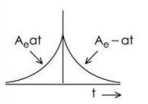
Fourier transform or Fourier integral of a function f(t) is given by
Match the following :
List - I List - II (spectrum |G(w)| in the original figure) (a) Rectangular Pulse (i) 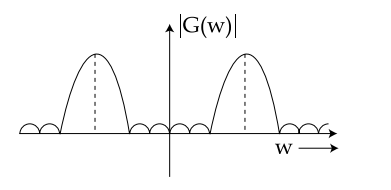
(b) Double-sided Exponential (ii) 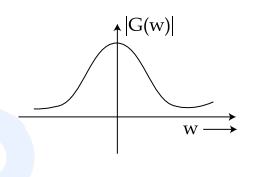
(c) Cosine Pulse (iii) 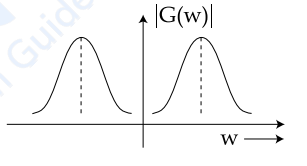
(d) Damped Sine (iv) 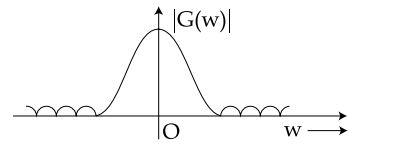
Codes :


