
In the following statements:
A. Congugate functions are the property of Fourier transform
B. $P_r = \frac{P_t G_t G_r}{L_p}$ is the Friis equation
C. The increase of power level from 13 to 36 watts is 8
D. Auto correlation function of a real valued energy signal is a real value odd function
E. $\int_{-\infty}^{\infty} |g (t)|^2 dt = \int_{0}^{\infty} |G (f)|^2 df$
Choose the correct answer from the options given below:
Analyzing the Statements for Fourier Transform and Communications Concepts
This section provides a detailed analysis of each statement presented in the question to determine their correctness, focusing on concepts related to Fourier Transforms and communication systems.
Statement A: Congugate functions are the property of Fourier transform
This statement refers to the relationship between a function and its complex conjugate in the context of Fourier Transforms. For a real-valued function $g(t)$, its Fourier Transform $G(f)$ possesses a property known as conjugate symmetry. Specifically, the Fourier Transform of $g(t)$ satisfies the condition:
$G(-f) = G^*(f)$
where $G^*(f)$ denotes the complex conjugate of $G(f)$. This property demonstrates that conjugate functions are indeed an inherent characteristic or property associated with the Fourier Transform, particularly when dealing with real signals. Thus, statement A is considered correct.
Statement B: $P_r = \frac{P_t G_t G_r}{L_p}$ is the Friis equation
The Friis transmission equation fundamentally describes the power received by an antenna relative to the power transmitted by another antenna, considering factors like antenna gains and path loss. The equation is often expressed in various forms. The form given, $P_r = \frac{P_t G_t G_r}{L_p}$, represents a valid formulation of the Friis equation, where:
- $P_r$ is the received power.
- $P_t$ is the transmitted power.
- $G_t$ is the gain of the transmitting antenna.
- $G_r$ is the gain of the receiving antenna.
- $L_p$ represents the total path loss factor, which accounts for the distance, frequency, and potentially includes the effects of antenna gains depending on its definition.
A common explicit form is $P_r = P_t G_t G_r \left(\frac{\lambda}{4 \pi d}\right)^2$. If $L_p$ is defined appropriately to encompass the path loss term including antenna gains, the provided equation holds true. Therefore, statement B is correct.
Statement C: The increase of power level from 13 to 36 watts is 8
Power level changes are typically measured in decibels (dB). The formula to calculate the change in power level ($\Delta L$) in dB is:
$ \Delta L = 10 \log_{10} \left( \frac{P_{high}}{P_{low}} \right) $
Substituting the given values $P_{high} = 36$ W and $P_{low} = 13$ W:
$ \Delta L = 10 \log_{10} \left( \frac{36}{13} \right) $
Calculating the ratio:
$ \frac{36}{13} \approx 2.769 $
Now, calculate the logarithm:
$ \Delta L \approx 10 \times \log_{10}(2.769) $
$ \Delta L \approx 10 \times 0.4423 $
$ \Delta L \approx 4.423 \text{ dB} $
The calculated increase is approximately 4.423 dB, not 8. Therefore, statement C is incorrect.
Statement D: Auto correlation function of a real valued energy signal is a real value odd function
The autocorrelation function $R_{xx}(\tau)$ for a real-valued energy signal $x(t)$ is defined as:
$ R_{xx}(\tau) = \int_{-\infty}^{\infty} x(t) x(t+\tau) dt $
To determine if it's an odd function, we examine $R_{xx}(-\tau)$:
$ R_{xx}(-\tau) = \int_{-\infty}^{\infty} x(t) x(t-\tau) dt $
By substituting $t' = t + \tau$ (which implies $t = t' - \tau$), the integral becomes:
$ R_{xx}(-\tau) = \int_{-\infty}^{\infty} x(t'-\tau) x(t') dt' $
Since $x(t)$ is real, $x(t)x(t+\tau) = x(t+\tau)x(t)$. Let's rewrite the integral with $t$ as the variable:
$ R_{xx}(-\tau) = \int_{-\infty}^{\infty} x(u) x(u+\tau) du $ where $u = t - \tau$.
This evaluates to $R_{xx}(\tau)$. The property $R_{xx}(-\tau) = R_{xx}(\tau)$ indicates that the autocorrelation function of a real-valued signal is always an even function, not an odd function. Thus, statement D is incorrect.
Statement E: $\int_{-\infty}^{\infty} |g (t)|^2 dt = \int_{0}^{\infty} |G (f)|^2 df$
This statement relates the signal's energy in the time domain to its energy in the frequency domain. Parseval's theorem states that the total energy of a signal is conserved under the Fourier Transform. Depending on the normalization convention used for the Fourier Transform, the theorem is typically stated as:
$ \int_{-\infty}^{\infty} |g (t)|^2 dt = \frac{1}{2\pi} \int_{-\infty}^{\infty} |G (f)|^2 df $
or
$ \int_{-\infty}^{\infty} |g (t)|^2 dt = \int_{-\infty}^{\infty} |G (f)|^2 df $
The crucial point is that the integration in the frequency domain must be over the entire spectrum, from $-\infty$ to $\infty$. The given statement limits the frequency integral to $[0, \infty)$, which is incorrect. Therefore, statement E is incorrect.
Conclusion
Based on the analysis:
- Statement A is correct.
- Statement B is correct.
- Statement C is incorrect.
- Statement D is incorrect.
- Statement E is incorrect.
Therefore, the correct statements are A and B.
Important Questions from Fourier Transform
- Match the LIST-I with LIST-IIChoose the correct answer from the options given below:
LIST-I LIST-II A. Continuous and periodic signal I. continuous time Fourier series B. Continuous and aperiodic signal II. discrete time Fourier series C. Discrete and periodic signal III. continuous time Fourier transform D. Discrete and aperiodic signal IV. discrete time Fourier transform - The Fourier transform of the signal $x(t)=e^{at}u(-t)$, $a0$ is
The Fourier transform for the given waveform.
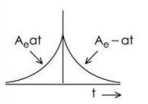
Fourier transform or Fourier integral of a function f(t) is given by
Match the following :
List - I List - II (spectrum |G(w)| in the original figure) (a) Rectangular Pulse (i) 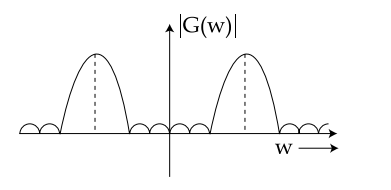
(b) Double-sided Exponential (ii) 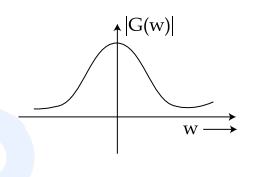
(c) Cosine Pulse (iii) 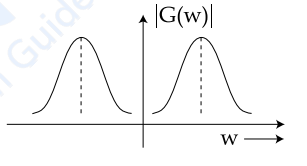
(d) Damped Sine (iv) 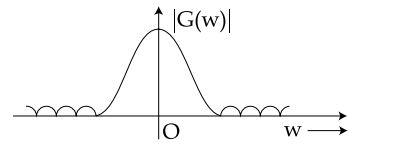
Codes :


