
Benzaldehyde, p-Tolualdehyde, p-Nitrobenzaldehyde, Acetophenone
Understanding Reactivity Towards Nucleophilic Addition
The reactivity of carbonyl compounds (aldehydes and ketones) towards nucleophilic addition reactions depends primarily on two factors:
- Electrophilicity of the Carbonyl Carbon: A higher degree of positive charge (electrophilicity) on the carbonyl carbon atom attracts nucleophiles more strongly, increasing reactivity. Electron-withdrawing groups enhance electrophilicity, while electron-donating groups decrease it.
- Steric Hindrance: Bulky groups surrounding the carbonyl carbon can hinder the approach of the nucleophile, decreasing reactivity.
Analysis of Specific Compounds
Let's analyze the given compounds:
- p-Nitrobenzaldehyde: Contains a strong electron-withdrawing nitro group ($-NO_2$) attached to the benzene ring. This group withdraws electron density via both inductive ($-I$) and resonance ($-R$) effects. This significantly increases the electrophilicity of the carbonyl carbon ($C=O$), making it highly reactive towards nucleophiles.
- Benzaldehyde: Contains a phenyl group ($-C_6H_5$). The phenyl group withdraws electron density primarily via resonance ($-R$ effect), making the carbonyl carbon more electrophilic than in aliphatic aldehydes, but less so than in p-Nitrobenzaldehyde.
- p-Tolualdehyde: Contains a methyl group ($-CH_3$) in the para position of the benzene ring. The methyl group is electron-donating via hyperconjugation and inductive ($+I$) effects. This donation reduces the electrophilicity of the carbonyl carbon compared to benzaldehyde, thus decreasing reactivity.
- Acetophenone: This is a ketone. Ketones are generally less reactive than aldehydes towards nucleophilic addition due to increased steric hindrance (two non-hydrogen groups attached to the carbonyl carbon) and electronic effects. In acetophenone, the phenyl group withdraws electrons, but the methyl group donates electrons. The combination, along with steric hindrance, makes it the least reactive among the given compounds.
Determining the Reactivity Order
Based on the analysis:
- $p-Nitrobenzaldehyde$ exhibits the highest reactivity due to the potent electron-withdrawing effect of the $-NO_2$ group.
- $Benzaldehyde$ is less reactive than $p-Nitrobenzaldehyde$ due to the weaker withdrawing effect of the phenyl group.
- $p-Tolualdehyde$ is less reactive than $Benzaldehyde$ because the electron-donating methyl group reduces the carbonyl carbon's electrophilicity.
- $Acetophenone$ is the least reactive due to its ketone nature, which involves greater steric hindrance and a balance of electronic effects that overall reduce reactivity compared to aldehydes.
Therefore, the increasing order of reactivity is:
$Acetophenone < p-Tolualdehyde < Benzaldehyde < p-Nitrobenzaldehyde$
Important Questions from Aldehydes, Ketones and Carboxylic Acids
Phenol is brominated in solvent CS₂ at low temperature. The product formed are:
What is not true regarding compound [B]?
(A) They are higher boiling liquids than aldehydes and ketones due to extensive H bonding
(B) They are soluble in Benzene
(C) They produce alkane when heated with soda lime
(D) Produces CO₂ when treated with NaHCO₃
Choose the correct answer from the options given below:
Which of the following is the correct statement for hybridization of C-atom and number of π bonds in the Carbonyl group?
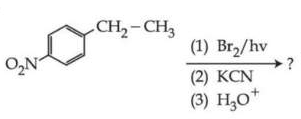
What is the product formed in the following reaction sequence?
What will be the product formed when cyclohexanone undergoes Aldol condensation?


