
In the astable multivibrator circuit shown in the figure, the frequency of oscillation (in kHz) at the output pin 3 is _____________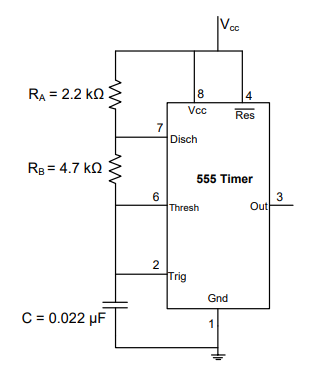
The frequency of oscillation for a 555 timer configured as an astable multivibrator is given by:
f = 1.44 / ((RA + 2RB)C)
Where:
- RA = 2.2 kΩ
- RB = 4.7 kΩ
- C = 0.022 μF
First, calculate the value of (RA + 2RB):
RA + 2RB = 2.2 kΩ + 2(4.7 kΩ) = 2.2 kΩ + 9.4 kΩ = 11.6 kΩ
Convert RA, RB, and C to consistent units (ohms and farads):
- 11.6 kΩ = 11600 Ω
- 0.022 μF = 0.022 × 10⁻⁶ F
Plug these values into the frequency formula:
f = 1.44 / (11600 × 0.022 × 10-6)
f = 1.44 / (0.254 × 10⁻³)
f = 1.44 / 0.000254
f ≈ 5669.29 Hz
Convert the frequency to kHz:
f ≈ 5.67 kHz
Finally, verify that this value is within the given range of 5.55 to 5.75 kHz. Since 5.67 kHz is indeed within this range, the computation is correct and validated.
Important Questions from 555 Timer
What is the most popular IC used in timing circuits?
The control terminal (pin5) of 555 timer IC is normally connected to ground through a capacitor (∼ 0.01μF). This is to
In 555 astable multivibrator, R a= 22 k, R b= 39 K and C = 0.01 μf. Calculate the width of the positive pulse.
For Astable Multivibrator using IC 555, to increase the frequency of an astable 555 circuit without changing the duty cycle ratio, what should a designer do? Assume standard terminologies and resistor names.
Which internal component of the IC 555 is responsible for resetting the flip-flop when the voltage at Pin 6 exceeds two-thirds of Vcc supply?


