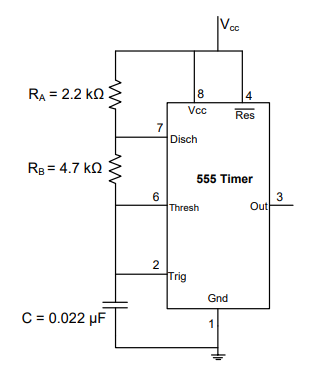
What is the most popular IC used in timing circuits?
555
The question asks to identify the most popular IC (Integrated Circuit) specifically used in timing circuits. Understanding the primary functions of common electronic components is essential for selecting the correct answer.
Timing Circuits Overview
Timing circuits are fundamental electronic configurations designed to generate precise time delays, oscillations, or specific pulse widths. These circuits are indispensable in a wide array of electronic applications, ranging from simple indicators and alarms to complex digital systems and automated controls.
- They utilize components such as resistors, capacitors, and active devices (like Integrated Circuits) to accurately control the duration of events or the frequency of signals.
- The selection of the appropriate IC is critical as it significantly influences the circuit's performance, stability, and overall design complexity.
Popular IC for Timing Circuits: The 555 Timer
Among the options provided, the 555 timer IC is universally recognized as the most widely used and highly popular integrated circuit for various timing circuit applications. Its immense popularity is attributed to its exceptional versatility, cost-effectiveness, and ease of implementation in diverse designs.
- The 555 timer IC, commonly referred to simply as the "555 timer," can operate effectively in three primary modes:
- Astable Mode: In this configuration, the 555 timer produces a continuous, repetitive output pulse train. This makes it an ideal choice for creating oscillators, square wave generators, and reliable clock signals for digital systems.
- Monostable Mode: When operating in this mode, the 555 timer generates a single output pulse of a predetermined duration upon receiving an external trigger. This functionality is highly useful for applications requiring precise timed delays, single pulse generation, or detecting missing pulses.
- Bistable Mode: Although less frequently used for basic timing applications, the 555 timer can also be configured to function as a flip-flop, essentially acting as a basic memory latch or an electronic switch.
- Its robust design and compatibility with a broad range of supply voltages (typically from 4.5V to 16V) further solidify its position as a go-to component for electronics enthusiasts and professionals.
- Common applications that highlight the versatility of the 555 timer IC include LED flashers, tone generators, pulse width modulation (PWM) controllers, and various sequential control systems.
Analysis of Other IC Options
To provide a comprehensive understanding, let's briefly examine the other integrated circuit options presented and explain why they are not the primary choice for general timing circuits:
- 741: This refers to the LM741 operational amplifier, commonly known as an op-amp. While op-amps are incredibly versatile building blocks and can be utilized to construct complex timing circuits (e.g., as integrators, differentiators, or comparators within oscillator designs), the 741 is a general-purpose amplifier. It is primarily designed for signal amplification and processing, not as a dedicated timer like the 555.
- 317: This typically refers to the LM317, which is a highly popular adjustable positive voltage regulator. Its fundamental function is to provide a stable, regulated output voltage, making it unsuitable for generating timing pulses or delays directly.
- 340: This designation can refer to various ICs, but commonly, the LM340 series are fixed-voltage regulators (e.g., LM340-5.0 for a fixed 5V output) or in some cases, specific types of op-amps or comparators. Similar to the 317, its core purpose does not involve timing functions.
Conclusion
Considering its specific design for timing applications, its wide array of operational modes (astable, monostable), and its widespread adoption across countless electronic projects, the 555 timer IC is unequivocally the most popular integrated circuit used in timing circuits. Its combination of simplicity, reliability, and cost-effectiveness has established it as a fundamental component for hobbyists, students, and experienced engineers alike.
Important Questions from 555 Timer
The control terminal (pin5) of 555 timer IC is normally connected to ground through a capacitor (∼ 0.01μF). This is to
For Astable Multivibrator using IC 555, to increase the frequency of an astable 555 circuit without changing the duty cycle ratio, what should a designer do? Assume standard terminologies and resistor names.
Which internal component of the IC 555 is responsible for resetting the flip-flop when the voltage at Pin 6 exceeds two-thirds of Vcc supply?
In 555 astable multivibrator, R a= 22 k, R b= 39 K and C = 0.01 μf. Calculate the width of the positive pulse.
In the astable multivibrator circuit shown in the figure, the frequency of oscillation (in kHz) at the output pin 3 is _____________