
In a solenoid, the current flowing through the wire is I and number of turns per unit length is n. This gives a magnetic field B inside the solenoid. If number of turn per unit length is increased to 2n, what will be the value of magnetic field in the solenoid?
2B
Understanding Magnetic Field in a Solenoid
This question asks about the magnetic field strength inside a solenoid and how it changes when the number of turns per unit length is altered.
A solenoid is essentially a coil of wire wound into a tightly packed helix. When an electric current flows through the wire of a solenoid, it produces a magnetic field. The magnetic field inside a long solenoid is known to be very uniform and strong, particularly along its axis, and relatively weak outside.
Formula for Magnetic Field Inside a Solenoid
The magnitude of the magnetic field (\(B\)) inside a long solenoid is given by the formula:
\(B = \mu_0 n I\)
Where:
- \(B\) is the magnitude of the magnetic field inside the solenoid.
- \(\mu_0\) is the permeability of free space, a constant value.
- \(n\) is the number of turns per unit length of the solenoid.
- \(I\) is the current flowing through the wire of the solenoid.
This formula shows that the magnetic field inside the solenoid is directly proportional to the permeability of the medium (\(\mu_0\)), the number of turns per unit length (\(n\)), and the current (\(I\)) flowing through the wire.
Analyzing the Initial and Changed Conditions
Let's break down the given information:
Initial State:
- Current flowing through the wire = \(I\)
- Number of turns per unit length = \(n\)
- Magnetic field inside the solenoid = \(B\)
Using the formula, the initial magnetic field is \(B = \mu_0 n I\).
Changed State:
- Current flowing through the wire remains = \(I\) (The question states the current is \(I\)).
- Number of turns per unit length is increased to = \(2n\)
- Magnetic field inside the solenoid = Let's call this new field \(B'\).
Now, let's calculate the new magnetic field \(B'\) using the same formula but with the new number of turns per unit length (\(2n\)) and the same current (\(I\)).
Calculating the New Magnetic Field
For the changed state, the formula for the magnetic field \(B'\) is:
\(B' = \mu_0 (2n) I\)
\(B' = 2 \mu_0 n I\)
We know from the initial state that the original magnetic field \(B\) was given by \(B = \mu_0 n I\).
Comparing the expression for \(B'\) with the expression for \(B\), we can see that:
\(B' = 2 (\mu_0 n I)\)
\(B' = 2B\)
Therefore, when the number of turns per unit length is doubled (from \(n\) to \(2n\)) while the current remains the same, the magnetic field inside the solenoid doubles.
Comparing Results
Initial magnetic field = \(B\)
New magnetic field = \(B'\)
We found that \(B' = 2B\).
This means the new magnetic field is twice the original magnetic field.
Let's look at the options provided:
- B
- 2B
- B / 2
- B / 4
Our calculated new magnetic field is \(2B\), which matches option 2.
Conclusion on Magnetic Field Change
The magnetic field inside a long solenoid is directly proportional to the number of turns per unit length (\(n\)) and the current (\(I\)). When \(n\) is doubled and \(I\) remains constant, the magnetic field strength also doubles. This is a direct consequence of the linear relationship between \(B\), \(n\), and \(I\) in the formula \(B = \mu_0 n I\).
Revision Table: Solenoid Properties and Magnetic Field
| Property | Symbol/Description | Effect on Magnetic Field (B = μ0 n I) |
|---|---|---|
| Permeability of Free Space | μ0 (constant) | Directly proportional |
| Number of turns per unit length | n | Directly proportional |
| Current flowing through the wire | I | Directly proportional |
Additional Information: Long vs. Finite Solenoids
The formula \(B = \mu_0 n I\) is strictly accurate for an infinitely long solenoid or approximately accurate for a very long solenoid far from its ends. For a finite length solenoid, the magnetic field is strongest and most uniform near the center but decreases as you move towards the ends. At the ends of a long solenoid, the magnetic field strength is approximately half of the value at the center (\(B_{end} \approx \frac{1}{2} \mu_0 n I\)). However, for the purpose of this type of problem involving a solenoid, it is generally assumed to be long enough for the uniform field formula to apply unless otherwise specified.
Also, the magnetic field inside a solenoid is parallel to its axis.
Similar Questions
- According to Fleming's right-hand rule, if the forefinger indicates the direction of the magnetic field and the thumb shows the direction of motion of the conductor, then the stretched middle finger will predict the direction of
A circular coil of radius R having N number of turns carries a steady current I. The magnetic induction at the centre of the coil is 0.1 tesla. If the number of turns is doubled and the radius is halved, which one of the following will be the correct value for the magnetic induction at the centre of the coil?
Consider the following image:
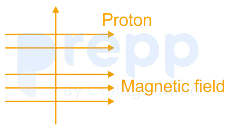
A proton enters a magnetic field at right angles to it, as shown above. The direction of force acting on the proton will be
Consider the following statements about a solenoid:
1. The magnetic field strength in a solenoid depends upon the number of turns per unit length in the solenoid
2. The magnetic field strength in a solenoid depends upon the current flowing in the wire of the solenoid
3. The magnetic field strength in a solenoid depends upon the diameter of the solenoid
Which of the statements given above are correct?
Important Questions from Magnetic Force on a Current-Carrying Wire
- According to Fleming's right-hand rule, if the forefinger indicates the direction of the magnetic field and the thumb shows the direction of motion of the conductor, then the stretched middle finger will predict the direction of
A metallic rod of mass per unit length $0.5 \text{ kg m}^{-1}$ is lying horizontally on a smooth inclined plane which makes an angle of $30^\circ$ with the horizontal. The rod is not allowed to slide down by flowing a current through it when a magnetic field of induction $0.25 \text{ T}$ is acting on it, perpendicular to the inclined plane. The current flowing in the rod to keep it stationary is
A circular coil of radius R having N number of turns carries a steady current I. The magnetic induction at the centre of the coil is 0.1 tesla. If the number of turns is doubled and the radius is halved, which one of the following will be the correct value for the magnetic induction at the centre of the coil?
Consider the following image:
A proton enters a magnetic field at right angles to it, as shown above. The direction of force acting on the proton will be
Consider the following statements about a solenoid:
1. The magnetic field strength in a solenoid depends upon the number of turns per unit length in the solenoid
2. The magnetic field strength in a solenoid depends upon the current flowing in the wire of the solenoid
3. The magnetic field strength in a solenoid depends upon the diameter of the solenoid
Which of the statements given above are correct?



