
Consider the following statements about a solenoid: 1. The magnetic field strength in a solenoid depends upon the number of turns per unit length in the solenoid 2. The magnetic field strength in a solenoid depends upon the current flowing in the wire of the solenoid 3. The magnetic field strength in a solenoid depends upon the diameter of the solenoid
1 and 2 only
Understanding the Magnetic Field Strength in a Solenoid
A solenoid is a coil of wire typically wound in a tightly packed helix. When an electric current flows through the wire, it generates a magnetic field. Inside a long, ideal solenoid, this magnetic field is strong and nearly uniform, running parallel to the axis of the coil. Understanding what factors influence the strength of this magnetic field is crucial in electromagnetism.
The magnetic field strength (\(\vec{B}\)) inside a long solenoid is given by the formula:
\( \vec{B} = \mu_0 n I \hat{z} \)
Where:
- \( B \) is the magnitude of the magnetic field strength.
- \( \mu_0 \) is the permeability of free space (a constant value).
- \( n \) is the number of turns per unit length of the solenoid.
- \( I \) is the current flowing through the wire of the solenoid.
- \( \hat{z} \) is a unit vector along the axis of the solenoid, indicating the direction of the field.
Let's analyze each statement provided in the question based on this formula and our understanding of solenoids.
Analyzing Statements About Solenoid Magnetic Field
We will examine each statement to determine its correctness regarding the factors affecting the magnetic field strength in a solenoid.
Statement 1: The magnetic field strength in a solenoid depends upon the number of turns per unit length in the solenoid.
- Looking at the formula \( B = \mu_0 n I \), we can see that the magnetic field strength \( B \) is directly proportional to \( n \), the number of turns per unit length. This means if you increase the number of turns in a given length, the magnetic field strength increases, assuming the current remains constant.
- Therefore, Statement 1 is correct.
Statement 2: The magnetic field strength in a solenoid depends upon the current flowing in the wire of the solenoid.
- The formula \( B = \mu_0 n I \) clearly shows that the magnetic field strength \( B \) is directly proportional to \( I \), the current flowing through the wire. A larger current produces a stronger magnetic field, assuming the number of turns per unit length remains constant.
- Therefore, Statement 2 is correct.
Statement 3: The magnetic field strength in a solenoid depends upon the diameter of the solenoid.
- The formula \( B = \mu_0 n I \) does not include the diameter or radius of the solenoid. For a long, ideal solenoid, the magnetic field inside is considered uniform across its cross-section and its strength depends only on the number of turns per unit length and the current. While the diameter affects the total volume enclosed by the solenoid and might be relevant for the total magnetic flux or energy stored, it does not affect the magnetic field strength at points well inside a long solenoid away from its ends.
- Therefore, Statement 3 is incorrect for a long solenoid.
Conclusion on Solenoid Magnetic Field Dependence
Based on our analysis of the statements and the formula for the magnetic field inside a solenoid, we find that the magnetic field strength depends on the number of turns per unit length and the current flowing through the wire, but not on the diameter (for a long, ideal solenoid).
The correct statements are 1 and 2.
Identifying the Correct Option
Comparing our findings with the given options:
- Option 1: 1, 2 and 3 (Incorrect, because 3 is incorrect)
- Option 2: 1 and 3 only (Incorrect, because 3 is incorrect)
- Option 3: 2 and 3 only (Incorrect, because 3 is incorrect)
- Option 4: 1 and 2 only (Correct, because statements 1 and 2 are correct)
Thus, the statements that correctly describe the factors influencing the magnetic field strength in a solenoid are 1 and 2.
Revision Table: Solenoid Magnetic Field Factors
| Factor | Influence on Magnetic Field (B) | Basis |
|---|---|---|
| Number of turns per unit length (n) | Directly proportional (B \(\propto\) n) | Formula \( B = \mu_0 n I \) |
| Current (I) | Directly proportional (B \(\propto\) I) | Formula \( B = \mu_0 n I \) |
| Diameter / Radius | No dependence (for long, ideal solenoid) | Not present in formula \( B = \mu_0 n I \) |
| Permeability of core material (\(\mu\)) | Directly proportional (B \(\propto\) \(\mu\)) | Formula becomes \( B = \mu n I \) if core is present |
Additional Information: Ideal vs. Real Solenoids and Core Materials
The formula \( B = \mu_0 n I \) is for an infinitely long solenoid in a vacuum or air (where permeability is approximately \( \mu_0 \)).
- Finite Solenoids: For a real, finite-length solenoid, the field near the ends is weaker and not perfectly uniform. The field strength at the center of a finite solenoid of length \(L\) and radius \(R\) with \(N\) total turns and current \(I\) is approximately \( B = \frac{\mu_0 N I}{\sqrt{L^2 + (2R)^2}} \). This formula still depends on \(N\) (related to \(n\)) and \(I\), but the diameter (\(R\)) and length (\(L\)) now influence the field strength, especially as \(R\) becomes comparable to \(L\). However, for a long solenoid (\(L >> R\)), the simple formula \( B = \mu_0 n I \) remains a good approximation inside, away from the ends. The question implies a general solenoid without specifying 'finite' or 'ideal', but standard solenoid problems often refer to the long solenoid approximation where the formula \( B = \mu_0 n I \) is used. In the context of this question and options, the standard formula is most relevant.
- Core Material: If the solenoid is wound around a material with a different magnetic permeability (\(\mu\)), such as iron, the formula changes to \( B = \mu n I \). Since \( \mu = \mu_r \mu_0 \) (where \( \mu_r \) is the relative permeability of the material), the magnetic field strength is greatly increased by inserting a ferromagnetic core. The presence and type of core material significantly affect the magnetic field strength. The question does not mention a core, so we assume it's air or vacuum, corresponding to \( \mu_0 \).
Therefore, while the diameter can have a minor influence in non-ideal cases, the fundamental factors determining the magnetic field strength inside a solenoid, as described by the primary formula and typically taught, are the number of turns per unit length and the current.
Similar Questions
- According to Fleming's right-hand rule, if the forefinger indicates the direction of the magnetic field and the thumb shows the direction of motion of the conductor, then the stretched middle finger will predict the direction of
A circular coil of radius R having N number of turns carries a steady current I. The magnetic induction at the centre of the coil is 0.1 tesla. If the number of turns is doubled and the radius is halved, which one of the following will be the correct value for the magnetic induction at the centre of the coil?
Consider the following image:
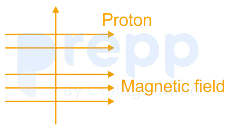
A proton enters a magnetic field at right angles to it, as shown above. The direction of force acting on the proton will be
In a solenoid, the current flowing through the wire is I and number of turns per unit length is n. This gives a magnetic field B inside the solenoid. If number of turn per unit length is increased to 2n, what will be the value of magnetic field in the solenoid?
Important Questions from Magnetic Force on a Current-Carrying Wire
- According to Fleming's right-hand rule, if the forefinger indicates the direction of the magnetic field and the thumb shows the direction of motion of the conductor, then the stretched middle finger will predict the direction of
A metallic rod of mass per unit length $0.5 \text{ kg m}^{-1}$ is lying horizontally on a smooth inclined plane which makes an angle of $30^\circ$ with the horizontal. The rod is not allowed to slide down by flowing a current through it when a magnetic field of induction $0.25 \text{ T}$ is acting on it, perpendicular to the inclined plane. The current flowing in the rod to keep it stationary is
A circular coil of radius R having N number of turns carries a steady current I. The magnetic induction at the centre of the coil is 0.1 tesla. If the number of turns is doubled and the radius is halved, which one of the following will be the correct value for the magnetic induction at the centre of the coil?
Consider the following image:
A proton enters a magnetic field at right angles to it, as shown above. The direction of force acting on the proton will be
In a solenoid, the current flowing through the wire is I and number of turns per unit length is n. This gives a magnetic field B inside the solenoid. If number of turn per unit length is increased to 2n, what will be the value of magnetic field in the solenoid?



