
A circular coil of radius R having N number of turns carries a steady current I. The magnetic induction at the centre of the coil is 0.1 tesla. If the number of turns is doubled and the radius is halved, which one of the following will be the correct value for the magnetic induction at the centre of the coil?
0.4 tesla
Calculating Magnetic Induction at the Center of a Circular Coil
The question asks us to find the new magnetic induction at the center of a circular coil when its physical parameters are changed. We are given the initial magnetic induction and the changes in the number of turns and radius.
Understanding the Formula for Magnetic Field
The magnetic induction (or magnetic field strength) at the center of a circular coil carrying a steady current is given by the formula:
\( B = \frac{\mu_0 N I}{2R} \)
Where:
- \( B \) is the magnetic induction at the center.
- \( \mu_0 \) is the permeability of free space (a constant).
- \( N \) is the number of turns in the coil.
- \( I \) is the steady current flowing through the coil.
- \( R \) is the radius of the coil.
From this formula, we can see that the magnetic field \( B \) is directly proportional to the number of turns \( N \) and the current \( I \), and inversely proportional to the radius \( R \).
Initial Conditions
We are given the initial conditions for the circular coil:
- Initial radius = \( R \)
- Initial number of turns = \( N \)
- Initial current = \( I \) (steady current)
- Initial magnetic induction at the center = \( B = 0.1 \) tesla
Using the formula, the initial magnetic induction can be written as:
\( 0.1 = \frac{\mu_0 N I}{2R} \)
Let's call this Equation (1).
Changed Conditions
The question states that the coil is changed as follows:
- The number of turns is doubled. New number of turns, \( N' = 2N \).
- The radius is halved. New radius, \( R' = \frac{R}{2} \).
- The current remains steady. New current, \( I' = I \).
Calculating the New Magnetic Induction
Now, let's use the formula for magnetic induction with the new parameters \( N' \), \( I' \), and \( R' \) to find the new magnetic induction \( B' \) at the center of the coil:
\( B' = \frac{\mu_0 N' I'}{2R'} \)
Substitute the new values: \( N' = 2N \), \( I' = I \), and \( R' = \frac{R}{2} \):
\( B' = \frac{\mu_0 (2N) (I)}{2(\frac{R}{2})} \)
Let's simplify the expression:
\( B' = \frac{\mu_0 2N I}{R} \)
We can rearrange this expression to relate it to the initial magnetic induction formula:
\( B' = 2 \times \frac{\mu_0 N I}{R} \)
To make it look exactly like Equation (1), we can rewrite it as:
\( B' = 4 \times \frac{\mu_0 N I}{2R} \)
Notice that the term \( \frac{\mu_0 N I}{2R} \) is exactly the initial magnetic induction \( B \) from Equation (1). So, we can substitute \( 0.1 \) tesla for this term:
\( B' = 4 \times (0.1 \text{ T}) \)
\( B' = 0.4 \text{ T} \)
Conclusion
When the number of turns in the circular coil is doubled and the radius is halved, while keeping the current steady, the magnetic induction at the center of the coil becomes 0.4 tesla.
Summary of Changes and Effect
| Parameter | Initial Value | Change | New Value | Effect on B (from formula \( B \propto N/R \)) |
|---|---|---|---|---|
| Number of Turns (N) | \( N \) | Doubled | \( N' = 2N \) | B becomes \( 2 \times \) original B |
| Radius (R) | \( R \) | Halved | \( R' = R/2 \) | B becomes \( 1/(1/2) = 2 \times \) original B |
| Current (I) | \( I \) | Steady | \( I' = I \) | No change in B due to current |
Since \( B \propto N/R \), the combined effect is that the new magnetic field \( B' \) will be proportional to \( (2N) / (R/2) \), which simplifies to \( 4N/R \). This is 4 times the original proportionality \( N/R \). Therefore, the new magnetic field is 4 times the original magnetic field.
\( B_{new} = 4 \times B_{original} \)
\( B_{new} = 4 \times 0.1 \text{ T} = 0.4 \text{ T} \)
Revision Table: Circular Coil Magnetic Field
| Concept | Formula | Key Factors |
|---|---|---|
| Magnetic field at coil center | \( B = \frac{\mu_0 N I}{2R} \) | Number of turns (N), Current (I), Radius (R) |
| Proportionality | \( B \propto \frac{NI}{R} \) | Directly proportional to N and I, Inversely proportional to R |
Additional Information: Magnetic Fields
Magnetic fields are regions around magnets or electric currents where magnetic forces can be observed. Magnetic induction (B) is a vector quantity that describes the strength and direction of the magnetic field at a point.
- Source of Magnetic Fields: Moving electric charges (currents) and intrinsic magnetic moments of elementary particles (like electrons) create magnetic fields.
- Units: The SI unit for magnetic induction is the tesla (T). Another common unit is the gauss (G), where 1 T = 10,000 G.
- Direction of Magnetic Field: For a circular coil, the direction of the magnetic field at the center can be determined using the right-hand rule. If you curl the fingers of your right hand in the direction of the current in the coil, your thumb points in the direction of the magnetic field at the center.
- Applications: Circular coils are fundamental components in many electrical devices, including electromagnets, motors, generators, and scientific instruments like solenoids and Helmholtz coils (which produce uniform magnetic fields).
Similar Questions
- According to Fleming's right-hand rule, if the forefinger indicates the direction of the magnetic field and the thumb shows the direction of motion of the conductor, then the stretched middle finger will predict the direction of
Consider the following image:
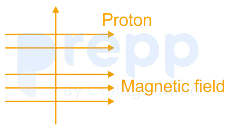
A proton enters a magnetic field at right angles to it, as shown above. The direction of force acting on the proton will be
Consider the following statements about a solenoid:
1. The magnetic field strength in a solenoid depends upon the number of turns per unit length in the solenoid
2. The magnetic field strength in a solenoid depends upon the current flowing in the wire of the solenoid
3. The magnetic field strength in a solenoid depends upon the diameter of the solenoid
Which of the statements given above are correct?In a solenoid, the current flowing through the wire is I and number of turns per unit length is n. This gives a magnetic field B inside the solenoid. If number of turn per unit length is increased to 2n, what will be the value of magnetic field in the solenoid?
Important Questions from Magnetic Force on a Current-Carrying Wire
- According to Fleming's right-hand rule, if the forefinger indicates the direction of the magnetic field and the thumb shows the direction of motion of the conductor, then the stretched middle finger will predict the direction of
A metallic rod of mass per unit length $0.5 \text{ kg m}^{-1}$ is lying horizontally on a smooth inclined plane which makes an angle of $30^\circ$ with the horizontal. The rod is not allowed to slide down by flowing a current through it when a magnetic field of induction $0.25 \text{ T}$ is acting on it, perpendicular to the inclined plane. The current flowing in the rod to keep it stationary is
Consider the following image:
A proton enters a magnetic field at right angles to it, as shown above. The direction of force acting on the proton will be
Consider the following statements about a solenoid:
1. The magnetic field strength in a solenoid depends upon the number of turns per unit length in the solenoid
2. The magnetic field strength in a solenoid depends upon the current flowing in the wire of the solenoid
3. The magnetic field strength in a solenoid depends upon the diameter of the solenoid
Which of the statements given above are correct?In a solenoid, the current flowing through the wire is I and number of turns per unit length is n. This gives a magnetic field B inside the solenoid. If number of turn per unit length is increased to 2n, what will be the value of magnetic field in the solenoid?



