
Understanding Fleming's Right-Hand Rule
Fleming's right-hand rule is a fundamental principle in electromagnetism used to determine the direction of the induced electric current when a conductor moves in a magnetic field. This rule is particularly useful in understanding the working of electrical generators.
Applying Fleming's Right-Hand Rule
The rule states that if you hold the thumb, forefinger, and middle finger of your right hand mutually perpendicular to each other, each finger points in a specific direction related to motion, magnetic field, and induced current.
- Thumb: Represents the direction of motion of the conductor.
- Forefinger: Represents the direction of the magnetic field (from North pole to South pole).
- Middle Finger: Represents the direction of the induced electric current.
The question describes a scenario exactly matching the application of this rule:
- The forefinger indicates the direction of the magnetic field.
- The thumb shows the direction of motion of the conductor.
- The stretched middle finger predicts the direction of the induced current.
Therefore, based on Fleming's right-hand rule, if the forefinger points in the direction of the magnetic field and the thumb points in the direction of the conductor's motion, the middle finger will indicate the direction of the induced current.
Analyzing the Options
Let's examine the given options in the context of Fleming's rules:
- force acting on the conductor: This is determined by Fleming's left-hand rule, which is used for a current-carrying conductor placed in a magnetic field (like in electric motors). The left-hand rule predicts the direction of the force. So, this option is incorrect for the right-hand rule.
- electric field: While a changing magnetic flux induces an electric field (Faraday's Law), Fleming's right-hand rule directly gives the direction of the induced *current*, not the electric field itself, although the induced current flows due to the induced electric field. This option is not the direct prediction of the middle finger in this rule.
- induced current: As explained by the rule, the middle finger of the right hand, when aligned according to the thumb (motion) and forefinger (magnetic field), specifically points in the direction of the induced current. This matches the rule precisely.
- current: This option is too general. Fleming's right-hand rule is used to determine the direction of *induced* current, which is a specific type of current generated by electromagnetic induction. Option 3 is more accurate and specific to the rule's purpose.
Based on the detailed explanation of Fleming's right-hand rule and the analysis of the options, the stretched middle finger predicts the direction of the induced current.
| Finger (Right Hand) | Represents | Context |
|---|---|---|
| Thumb | Direction of Motion | Conductor moving in magnetic field |
| Forefinger | Direction of Magnetic Field | North to South |
| Middle Finger | Direction of Induced Current | Current generated by induction |
Revision Table: Fleming's Rules Comparison
| Rule | Purpose | Thumb | Forefinger | Middle Finger |
|---|---|---|---|---|
| Fleming's Right-Hand Rule | Finding direction of induced current (Generators) | Motion | Magnetic Field | Induced Current |
| Fleming's Left-Hand Rule | Finding direction of force (Motors) | Force | Magnetic Field | Current (flowing) |
Additional Information: Electromagnetic Induction and Rules
Fleming's rules are derived from the principles of electromagnetic induction, discovered by Michael Faraday and formalized by James Clerk Maxwell. Electromagnetic induction is the phenomenon where a changing magnetic field through a coil or circuit induces an electromotive force (EMF), which can drive an electric current. The change in magnetic field can be due to:
- A conductor moving through a static magnetic field (as described in this question, leading to induced current).
- A changing magnetic field around a stationary conductor (e.g., a changing current in a nearby coil).
Fleming's right-hand rule is a mnemonic to help determine the direction of the induced current resulting from the motion of a conductor in a magnetic field. The magnitude of the induced EMF is given by Faraday's Law of Induction, and for a straight conductor moving perpendicular to a magnetic field, it's given by &(\mathcal{E} = Blv&), where &(\mathcal{E}&) is the induced EMF, & (B)&) is the magnetic field strength, & (l)&) is the length of the conductor, and & (v)&) is its velocity.
Similar Questions
A circular coil of radius R having N number of turns carries a steady current I. The magnetic induction at the centre of the coil is 0.1 tesla. If the number of turns is doubled and the radius is halved, which one of the following will be the correct value for the magnetic induction at the centre of the coil?
Consider the following image:
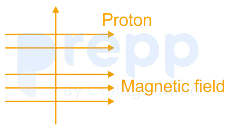
A proton enters a magnetic field at right angles to it, as shown above. The direction of force acting on the proton will be
Consider the following statements about a solenoid:
1. The magnetic field strength in a solenoid depends upon the number of turns per unit length in the solenoid
2. The magnetic field strength in a solenoid depends upon the current flowing in the wire of the solenoid
3. The magnetic field strength in a solenoid depends upon the diameter of the solenoid
Which of the statements given above are correct?In a solenoid, the current flowing through the wire is I and number of turns per unit length is n. This gives a magnetic field B inside the solenoid. If number of turn per unit length is increased to 2n, what will be the value of magnetic field in the solenoid?
Important Questions from Magnetic Force on a Current-Carrying Wire
A metallic rod of mass per unit length $0.5 \text{ kg m}^{-1}$ is lying horizontally on a smooth inclined plane which makes an angle of $30^\circ$ with the horizontal. The rod is not allowed to slide down by flowing a current through it when a magnetic field of induction $0.25 \text{ T}$ is acting on it, perpendicular to the inclined plane. The current flowing in the rod to keep it stationary is
A circular coil of radius R having N number of turns carries a steady current I. The magnetic induction at the centre of the coil is 0.1 tesla. If the number of turns is doubled and the radius is halved, which one of the following will be the correct value for the magnetic induction at the centre of the coil?
Consider the following image:
A proton enters a magnetic field at right angles to it, as shown above. The direction of force acting on the proton will be
Consider the following statements about a solenoid:
1. The magnetic field strength in a solenoid depends upon the number of turns per unit length in the solenoid
2. The magnetic field strength in a solenoid depends upon the current flowing in the wire of the solenoid
3. The magnetic field strength in a solenoid depends upon the diameter of the solenoid
Which of the statements given above are correct?In a solenoid, the current flowing through the wire is I and number of turns per unit length is n. This gives a magnetic field B inside the solenoid. If number of turn per unit length is increased to 2n, what will be the value of magnetic field in the solenoid?



