
A long straight wire of radius $R$ carries a steady current $I$ uniformly distributed over its circular cross-section. According to Ampere's circuital law, which of the following correctly describes the magnitude of the magnetic field $B$ as a function of the radial distance $r$ from the wire's axis?
Magnetic Field Calculation Using Ampere's Law
This problem involves finding the magnetic field ($B$) generated by a long straight wire carrying a uniform current ($I$) distributed over its circular cross-section. We need to determine how the magnetic field changes with the radial distance ($r$) from the center of the wire. We will use Ampere's circuital law for this. Ampere's law states that the line integral of the magnetic field ($B$) around a closed loop is proportional to the total electric current ($I_{enc}$) enclosed by that loop:
$\oint \vec{B} \cdot d\vec{l} = \mu_0 I_{enc}$
We need to consider two cases based on the radial distance $r$ compared to the wire's radius $R$. The constant $\mu_0$ is the permeability of free space.
Magnetic Field Outside the Wire ($r > R$)
First, let's consider the region outside the wire, where the radial distance $r$ is greater than the radius $R$ of the wire ($r > R$).
- Amperian Loop: We choose a circular loop of radius $r$ centered on the axis of the wire. This loop lies entirely outside the wire.
- Symmetry: Due to the symmetry of the wire and the uniform current distribution, the magnetic field ($B$) must be constant in magnitude along this circular loop and tangential to it.
- Applying Ampere's Law: The integral becomes $B \times (2\pi r)$, since the path length is the circumference of the loop.
- Enclosed Current ($I_{enc}$): For a loop outside the wire, the enclosed current is the total current carried by the wire, which is $I$.
- Result: Applying Ampere's law, we get:
$B \cdot (2\pi r) = \mu_0 I$
Solving for $B$, we find:
$B = \frac{\mu_0 I}{2\pi r}$
This formula applies for $r > R$. Notice that the magnetic field decreases as $1/r$ outside the wire.
Magnetic Field Inside the Wire ($r \le R$)
Next, let's consider the region inside the wire, where the radial distance $r$ is less than or equal to the radius $R$ ($r \le R$).
- Amperian Loop: We choose a circular loop of radius $r$ centered on the axis of the wire, lying entirely within the wire.
- Symmetry: Similar to the outside case, the magnetic field ($B$) is constant in magnitude along this loop and tangential to it.
- Applying Ampere's Law: The integral is again $B \times (2\pi r)$.
- Enclosed Current ($I_{enc}$): This is the crucial part. Since the current $I$ is uniformly distributed over the cross-sectional area $A = \pi R^2$, the current density ($J$) is constant:
$J = \frac{I}{A} = \frac{I}{\pi R^2}$
The current enclosed by the Amperian loop of radius $r$ is the current density multiplied by the area of the loop ($A_{enc} = \pi r^2$):
$I_{enc} = J \times A_{enc} = \left( \frac{I}{\pi R^2} \right) \times (\pi r^2) = \frac{I r^2}{R^2}$
- Result: Substituting this enclosed current into Ampere's law:
$B \cdot (2\pi r) = \mu_0 \left( \frac{I r^2}{R^2} \right)$
Solving for $B$, we get:
$B = \frac{\mu_0 I r^2}{2\pi r R^2} = \frac{\mu_0 I r}{2\pi R^2}$
This formula applies for $r \le R$. The magnetic field increases linearly with $r$ inside the wire, reaching its maximum value at the surface ($r=R$).
Summary of Magnetic Field
Combining the results for both regions:
- Inside the wire ($r \le R$): $B = \frac{\mu_0 I r}{2\pi R^2}$
- Outside the wire ($r > R$): $B = \frac{\mu_0 I}{2\pi r}$
Comparing this with the given options, the correct description is:
$B = \frac{\mu_0 I r}{2\pi R^2}$ for $r \le R$ and $B = \frac{\mu_0 I}{2\pi r}$ for $r > R$.
Important Questions from Magnetic Force on a Current-Carrying Wire
- According to Fleming's right-hand rule, if the forefinger indicates the direction of the magnetic field and the thumb shows the direction of motion of the conductor, then the stretched middle finger will predict the direction of
A metallic rod of mass per unit length $0.5 \text{ kg m}^{-1}$ is lying horizontally on a smooth inclined plane which makes an angle of $30^\circ$ with the horizontal. The rod is not allowed to slide down by flowing a current through it when a magnetic field of induction $0.25 \text{ T}$ is acting on it, perpendicular to the inclined plane. The current flowing in the rod to keep it stationary is
A circular coil of radius R having N number of turns carries a steady current I. The magnetic induction at the centre of the coil is 0.1 tesla. If the number of turns is doubled and the radius is halved, which one of the following will be the correct value for the magnetic induction at the centre of the coil?
Consider the following image:
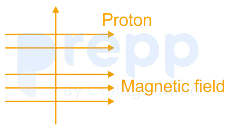
A proton enters a magnetic field at right angles to it, as shown above. The direction of force acting on the proton will be
Consider the following statements about a solenoid:
1. The magnetic field strength in a solenoid depends upon the number of turns per unit length in the solenoid
2. The magnetic field strength in a solenoid depends upon the current flowing in the wire of the solenoid
3. The magnetic field strength in a solenoid depends upon the diameter of the solenoid
Which of the statements given above are correct?


