
In a laboratory, a researcher rotates a non-circular conductive frame with variable angular speed through a spatially non-uniform magnetic field. Which outcome below most accurately describes how the induced electromotive force (emf) would behave during a complete rotation?
The emf will display irregular peaks and troughs reflecting both the changing angular speed and the field's spatial variation.
By Faraday's law, the induced emf equals the rate of change of magnetic flux: \(e = -\frac{d\Phi}{dt}\), where \(\Phi = \int \vec{B} \cdot d\vec{A}\).
For a frame rotating in a field, \(\frac{d\Phi}{dt}\) depends on how fast the angle changes (angular speed ω) and on how the flux varies with position.
A pure sinusoidal emf \(e = NBA\omega \sin \omega t\) arises only when the coil is a regular plane loop, the field is uniform and ω is constant.
Here ω varies, so the rate of flux change speeds up and slows down; the field is non-uniform and the frame is non-circular, so the flux changes unevenly with angle. The emf therefore shows irregular peaks and troughs.
A constant emf would need a steady rate of flux change, which a rotating frame cannot give. Zeros at regular intervals and a uniform sinusoid both require constant ω and a uniform field, neither of which holds here.
Hence, the answer is The emf will display irregular peaks and troughs reflecting both the changing angular speed and the field's spatial variation.
Similar Questions
A coil has 100 turns. If the magnetic flux linked with each turn changes by 0.05 Wb in 1 s, the induced emf is:
Important Questions from Faraday's Law
The figure shows an arbitrarily shaped planar conducting loop A in the XY plane. Two nonintersecting regions with areas $a_1$ and $a_2$ within the loop are subjected to magnetic fields $\vec{B}_1 = \frac{m}{\sqrt{2}} \sin(\omega t) (1\hat{x} + 0\hat{y} + 1\hat{z})$, and
$\vec{B}_2 = -\frac{n}{\sqrt{2}} \cos(2\omega t + \pi/4) (0\hat{x} + 1\hat{y} + 1\hat{z})$, respectively.
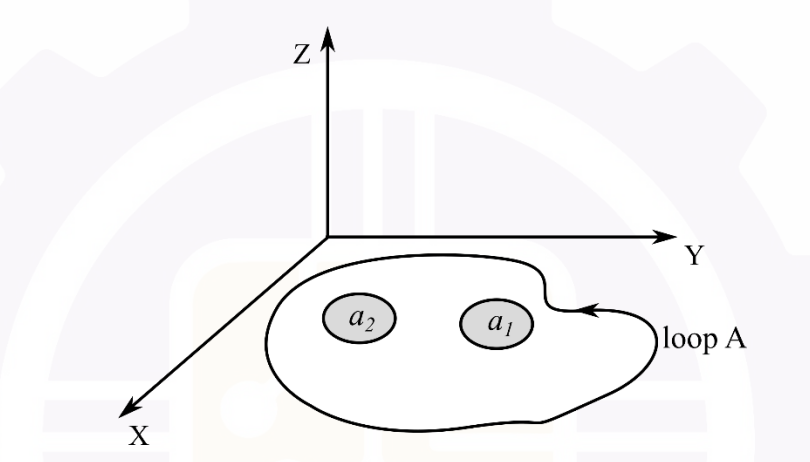
What is the expression for the induced rms voltage in loop A?
Which law is synonymous to the occurrence of diamagnetism?
For a tightly wound coil of wire, composed of N identical turns, each with the same ΦB, ________ of induction states that \(\varepsilon=-\dfrac{d\Phi_B}{dt}\) where N is the number of turns of wire and ΦB is the magnetic flux through a single loop.
Two resistors are connected in a circuit loop of area $5 \ m^2$, as shown in the figure below. The circuit loop is placed on the x-y plane.
When a time-varying magnetic flux, with flux-density $B(t) = 0.5t$ (in Tesla), is applied along the positive z-axis, the magnitude of current $I$ (in Amperes, rounded off to two decimal places) in the loop is __________.
If a copper conductor is moved across a magnetic field -



