
A coil has 100 turns. If the magnetic flux linked with each turn changes by 0.05 Wb in 1 s, the induced emf is:
5 V
By Faraday's law, the induced emf in a coil of N turns is \(e = N\frac{\Delta\Phi}{\Delta t}\) (in magnitude).
Given: N = 100, ΔΦ = 0.05 Wb per turn and Δt = 1 s.
\(e = 100 \times \frac{0.05}{1} = 5\ \text{V}\).
Hence, the answer is 5 V.
Similar Questions
In a laboratory, a researcher rotates a non-circular conductive frame with variable angular speed through a spatially non-uniform magnetic field. Which outcome below most accurately describes how the induced electromotive force (emf) would behave during a complete rotation?
Important Questions from Faraday's Law
The figure shows an arbitrarily shaped planar conducting loop A in the XY plane. Two nonintersecting regions with areas $a_1$ and $a_2$ within the loop are subjected to magnetic fields $\vec{B}_1 = \frac{m}{\sqrt{2}} \sin(\omega t) (1\hat{x} + 0\hat{y} + 1\hat{z})$, and
$\vec{B}_2 = -\frac{n}{\sqrt{2}} \cos(2\omega t + \pi/4) (0\hat{x} + 1\hat{y} + 1\hat{z})$, respectively.
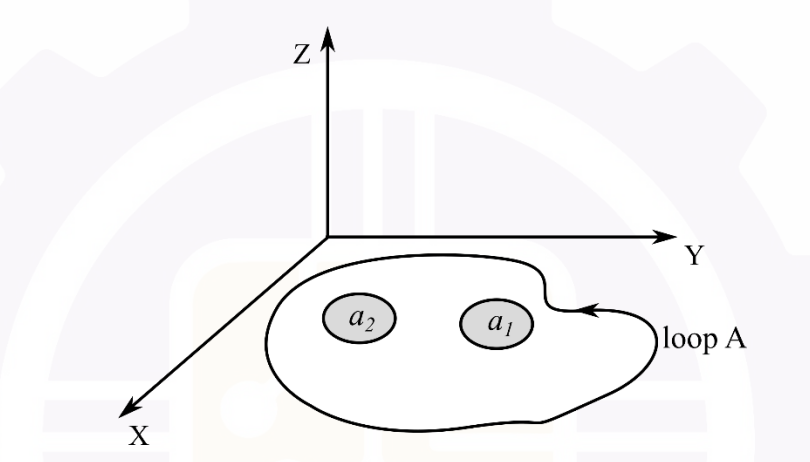
What is the expression for the induced rms voltage in loop A?
Which law is synonymous to the occurrence of diamagnetism?
For a tightly wound coil of wire, composed of N identical turns, each with the same ΦB, ________ of induction states that \(\varepsilon=-\dfrac{d\Phi_B}{dt}\) where N is the number of turns of wire and ΦB is the magnetic flux through a single loop.
Two resistors are connected in a circuit loop of area $5 \ m^2$, as shown in the figure below. The circuit loop is placed on the x-y plane.
When a time-varying magnetic flux, with flux-density $B(t) = 0.5t$ (in Tesla), is applied along the positive z-axis, the magnitude of current $I$ (in Amperes, rounded off to two decimal places) in the loop is __________.
If a copper conductor is moved across a magnetic field -



