
The figure shows an arbitrarily shaped planar conducting loop A in the XY plane. Two nonintersecting regions with areas $a_1$ and $a_2$ within the loop are subjected to magnetic fields $\vec{B}_1 = \frac{m}{\sqrt{2}} \sin(\omega t) (1\hat{x} + 0\hat{y} + 1\hat{z})$, and $\vec{B}_2 = -\frac{n}{\sqrt{2}} \cos(2\omega t + \pi/4) (0\hat{x} + 1\hat{y} + 1\hat{z})$, respectively. What is the expression for the induced rms voltage in loop A?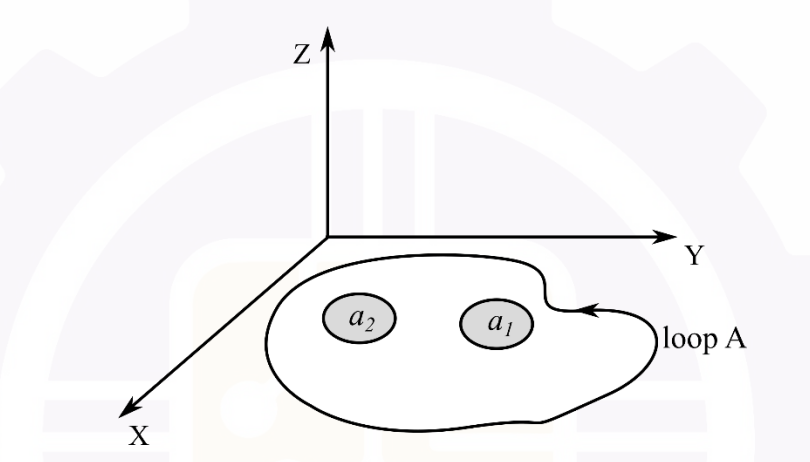
To determine the induced rms voltage in the loop A, we need to calculate the emf induced by the changing magnetic fields in the two areas, \(a_1\) and \(a_2\), and then find the rms value.
Concepts Involved
- Faraday's Law of Electromagnetic Induction, which states that the induced emf is equal to the negative rate of change of magnetic flux through the loop.
- Root mean square (rms) voltage, which for sinusoidal waveforms is given by \(V_{\text{rms}} = \frac{V_0}{\sqrt{2}}\).
Step-by-step Solution
- Calculate the magnetic flux \(\Phi_1\) through area \(a_1\) due to \(\vec{B}_1\):
- Magnetic flux: \(\Phi_1 = a_1 \times \left(\frac{m}{\sqrt{2}} \sin(\omega t)\right)\)
- Calculate the induced emf \(\varepsilon_1\) in this area using Faraday’s Law:
- \(\varepsilon_1 = -\frac{d\Phi_1}{dt} = -a_1 \frac{d}{dt}\left(\frac{m}{\sqrt{2}} \sin(\omega t)\right)\)
- Calculating the derivative: \(\varepsilon_1 = -a_1 \times \frac{m}{\sqrt{2}} \omega \cos(\omega t)\)
- Calculate the magnetic flux \(\Phi_2\) through area \(a_2\) due to \(\vec{B}_2\):
- Magnetic flux: \(\Phi_2 = a_2 \times \left(-\frac{n}{\sqrt{2}} \cos(2\omega t + \pi/4)\right)\)
- Calculate the induced emf \(\varepsilon_2\) in this area using Faraday’s Law:
- \(\varepsilon_2 = -\frac{d\Phi_2}{dt} = a_2 \frac{d}{dt}\left(\frac{n}{\sqrt{2}} \cos(2\omega t + \pi/4)\right)\)
- Calculating the derivative: \(\varepsilon_2 = a_2 \times \frac{n}{\sqrt{2}} \times 2\omega \sin(2\omega t + \pi/4)\)
- The total induced emf \(\varepsilon\) in the loop is the sum of \(\varepsilon_1\) and \(\varepsilon_2\):
- \(\varepsilon = \varepsilon_1 + \varepsilon_2\)
- Calculate the rms value of the total induced emf:
- The rms voltage expression is: \(V_{\text{rms}} = \sqrt{\frac{a_1^2 \omega^2 m^2 + 4a_2^2 \omega^2 n^2}{4}}\). This is derived from the root mean square formula considering both contributions independently and then summing them in quadrature.
Conclusion
The expression for the induced rms voltage in loop A is \(\sqrt{\frac{a_1^2 \omega^2 m^2 + 4a_2^2 \omega^2 n^2}{4}}\).
Important Questions from Faraday's Law
Which law is synonymous to the occurrence of diamagnetism?
For a tightly wound coil of wire, composed of N identical turns, each with the same ΦB, ________ of induction states that \(\varepsilon=-\dfrac{d\Phi_B}{dt}\) where N is the number of turns of wire and ΦB is the magnetic flux through a single loop.
Two resistors are connected in a circuit loop of area $5 \ m^2$, as shown in the figure below. The circuit loop is placed on the x-y plane.
When a time-varying magnetic flux, with flux-density $B(t) = 0.5t$ (in Tesla), is applied along the positive z-axis, the magnitude of current $I$ (in Amperes, rounded off to two decimal places) in the loop is __________.
If a copper conductor is moved across a magnetic field -
- Faraday's law of electromagnetic induction is mathematically described by which one of the following equations?


