
If a copper conductor is moved across a magnetic field -
A voltage will be induced in the wire
Conductor Movement in Magnetic Fields
When a copper conductor is moved across a magnetic field, a fundamental principle of electromagnetism known as Faraday's Law of Electromagnetic Induction comes into play. This law explains how a changing magnetic field through a conductor, or the movement of a conductor through a magnetic field, can create an electrical voltage. This is a core concept in the field of electrical engineering and physics, explaining how generators work to produce electricity.
Electromagnetic Induction Principles
Electromagnetic induction is the process by which an electromotive force (EMF), or voltage, is generated across an electrical conductor in a changing magnetic field. This phenomenon occurs under specific conditions:
- When a conductor moves through a stationary magnetic field, causing it to "cut" magnetic field lines. This relative motion is key to inducing voltage.
- When the magnetic field around a stationary conductor changes in strength or direction over time.
In the given scenario, a copper conductor is actively being moved across a magnetic field. This movement directly causes the conductor to cut the magnetic field lines. According to Faraday's Law, whenever a conductor cuts magnetic flux lines, an electromotive force (voltage) is induced across its ends. The magnitude of this induced voltage is directly proportional to the rate at which the magnetic flux is cut by the conductor. This principle is vital for understanding how electrical energy is generated.
Analyzing Conductor Options
Let's evaluate each provided option based on the principles of electromagnetic induction:
-
Option 1: The copper wire becomes magnetic
This statement is incorrect. Copper is classified as a diamagnetic material. Diamagnetic materials are very weakly repelled by magnetic fields and do not become permanently magnetized or even significantly temporarily magnetized when exposed to a magnetic field. Only ferromagnetic materials, such as iron, nickel, and cobalt, exhibit strong magnetic properties and can become magnetized.
-
Option 2: A voltage will be induced in the wire
This statement is correct. As explained by Faraday's Law of Electromagnetic Induction, the relative motion between the copper conductor and the magnetic field causes an electromotive force (EMF), or voltage, to be induced across the conductor. This is the direct and fundamental result of the conductor cutting the magnetic field lines. The induced voltage is the primary effect of this interaction.
-
Option 3: A current will be induced in the wire
While an induced voltage can certainly lead to an induced current, it's crucial to understand the sequence of events. First, a voltage (EMF) is induced across the conductor due to its motion in the magnetic field. For a current to flow, the conductor must be part of a complete, closed electrical circuit. If the circuit is open, a voltage will still be induced across the ends of the conductor, but no current will flow because there is no closed path for the charges to move. The question states the conductor is "moved across a magnetic field" without specifying a closed circuit, making the induction of voltage the more universally applicable and fundamental outcome.
-
Option 4: Nothing will happen
This statement is incorrect. The movement of a conductor through a magnetic field is a well-established physical phenomenon that leads to electromagnetic induction. A significant electrical effect, namely the induction of voltage, will indeed occur.
Induced Voltage Conclusion
Therefore, based on the principles of electromagnetic induction and Faraday's Law, when a copper conductor moves across a magnetic field, the immediate and fundamental effect is the induction of a voltage across the conductor. This induced voltage is the essential precursor to any induced current, which would only flow if a complete circuit were present.
Important Questions from Faraday's Law
The figure shows an arbitrarily shaped planar conducting loop A in the XY plane. Two nonintersecting regions with areas $a_1$ and $a_2$ within the loop are subjected to magnetic fields $\vec{B}_1 = \frac{m}{\sqrt{2}} \sin(\omega t) (1\hat{x} + 0\hat{y} + 1\hat{z})$, and
$\vec{B}_2 = -\frac{n}{\sqrt{2}} \cos(2\omega t + \pi/4) (0\hat{x} + 1\hat{y} + 1\hat{z})$, respectively.
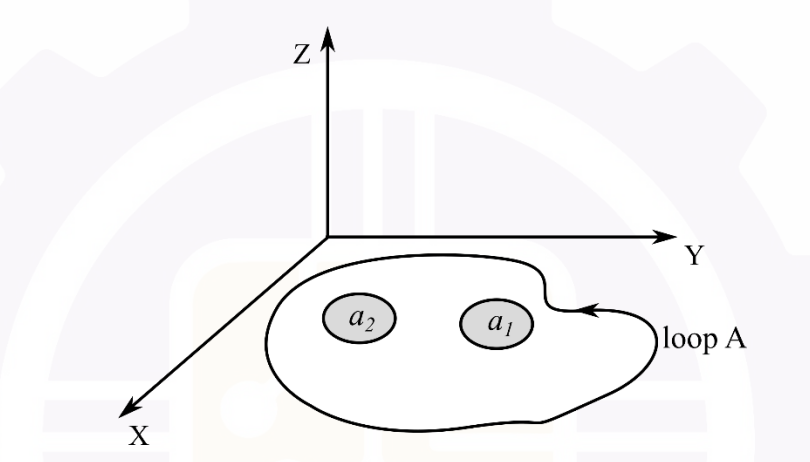
What is the expression for the induced rms voltage in loop A?
Which law is synonymous to the occurrence of diamagnetism?
For a tightly wound coil of wire, composed of N identical turns, each with the same ΦB, ________ of induction states that \(\varepsilon=-\dfrac{d\Phi_B}{dt}\) where N is the number of turns of wire and ΦB is the magnetic flux through a single loop.
Two resistors are connected in a circuit loop of area $5 \ m^2$, as shown in the figure below. The circuit loop is placed on the x-y plane.
When a time-varying magnetic flux, with flux-density $B(t) = 0.5t$ (in Tesla), is applied along the positive z-axis, the magnitude of current $I$ (in Amperes, rounded off to two decimal places) in the loop is __________.
- Faraday's law of electromagnetic induction is mathematically described by which one of the following equations?


