
$\nabla \times \vec{E} = -\frac{\partial \vec{B}}{\partial t}$
Faraday's Law of Induction Equation
Faraday's law of electromagnetic induction establishes the relationship between a changing magnetic field and the induced electric field (or electromotive force, EMF).
The mathematical representation of Faraday's law is:
$ \nabla \times \vec{E} = -\frac{\partial \vec{B}}{\partial t} $
This equation indicates that the curl of the electric field ($ \vec{E} $) is equal to the negative rate of change of the magnetic field ($ \vec{B} $) over time. This principle is fundamental to understanding electromagnetic induction.
Distinguishing Faraday's Law from Other Laws
The other equations presented represent different fundamental laws of electromagnetism:
- $ \nabla \bullet \vec B = 0 $: This is Gauss's law for magnetism, stating that magnetic monopoles do not exist.
- $ \nabla \bullet \vec D = \rho_v $: This is Gauss's law for electricity, relating the electric displacement field ($ \vec{D} $) to electric charge density ($ \rho_v $).
- $ \nabla \times \vec H = \sigma \vec{E} + \frac{\partial \vec{D}}{\partial t} $: This is the Ampere-Maxwell law, describing how electric currents and changing electric fields create magnetic fields.
Therefore, the equation $ \nabla \times \vec{E} = -\frac{\partial \vec{B}}{\partial t} $ specifically defines Faraday's law of electromagnetic induction.
Important Questions from Faraday's Law
The figure shows an arbitrarily shaped planar conducting loop A in the XY plane. Two nonintersecting regions with areas $a_1$ and $a_2$ within the loop are subjected to magnetic fields $\vec{B}_1 = \frac{m}{\sqrt{2}} \sin(\omega t) (1\hat{x} + 0\hat{y} + 1\hat{z})$, and
$\vec{B}_2 = -\frac{n}{\sqrt{2}} \cos(2\omega t + \pi/4) (0\hat{x} + 1\hat{y} + 1\hat{z})$, respectively.
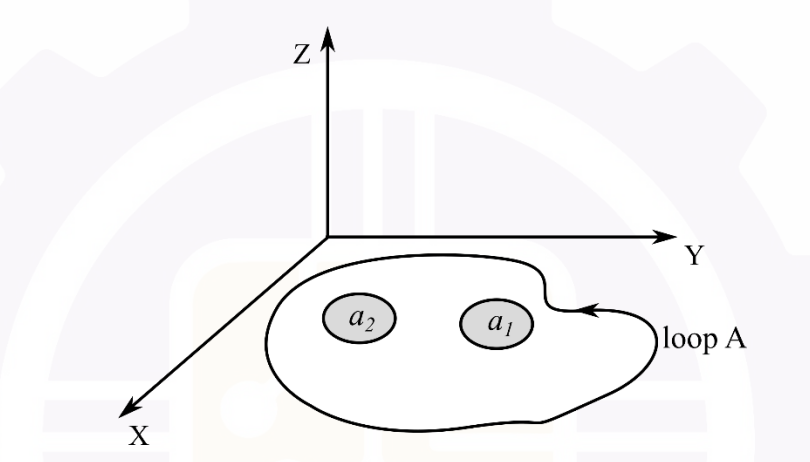
What is the expression for the induced rms voltage in loop A?
Which law is synonymous to the occurrence of diamagnetism?
For a tightly wound coil of wire, composed of N identical turns, each with the same ΦB, ________ of induction states that \(\varepsilon=-\dfrac{d\Phi_B}{dt}\) where N is the number of turns of wire and ΦB is the magnetic flux through a single loop.
Two resistors are connected in a circuit loop of area $5 \ m^2$, as shown in the figure below. The circuit loop is placed on the x-y plane.
When a time-varying magnetic flux, with flux-density $B(t) = 0.5t$ (in Tesla), is applied along the positive z-axis, the magnitude of current $I$ (in Amperes, rounded off to two decimal places) in the loop is __________.
If a copper conductor is moved across a magnetic field -


