
Which law is synonymous to the occurrence of diamagnetism?
Lenz's law
Diamagnetism Explained
Diamagnetism is a property of a material where it creates an induced magnetic field in opposition to an externally applied magnetic field. This means that diamagnetic materials are weakly repelled by a magnetic field. This phenomenon is a result of the orbital motion of electrons within atoms. When an external magnetic field is applied, it affects the motion of these electrons, inducing a current.
Lenz's Law and Diamagnetism
The occurrence of diamagnetism is directly synonymous with Lenz's law. Let's break down why:
- Lenz's law states that the direction of an induced electromotive force (EMF) and the resulting induced current is such that it opposes the change in magnetic flux that produced it. In simpler terms, if you try to change the magnetic field through a conductor, the conductor will generate its own magnetic field to fight that change.
- When an external magnetic field is applied to a diamagnetic material, it attempts to change the magnetic flux through the electron orbits within the atoms of that material.
- According to Lenz's law, this change in flux induces tiny current loops within the atoms. These induced currents create their own induced magnetic field.
- Crucially, this induced magnetic field is in the opposite direction to the applied external magnetic field. This opposition is precisely what defines diamagnetism – the material repelling the external field.
Therefore, the fundamental principle behind the repulsive nature of diamagnetic materials is the induced current creating an opposing magnetic field, which is exactly what Lenz's law describes.
Understanding Other Laws
To clarify why other options are not synonymous with diamagnetism:
- Ampere's law relates the magnetic field to the electric current producing it. While currents produce magnetic fields, Ampere's law doesn't specifically describe the *opposition* central to diamagnetism.
- Maxwell's laws are a set of four equations that describe how electric and magnetic fields are generated and altered by each other and by charges and currents. While Lenz's law is derived from Faraday's law of induction (one of Maxwell's equations), Maxwell's laws as a whole are a broader description of electromagnetism, not specifically synonymous with the occurrence of diamagnetism in the way Lenz's law is.
- Coulomb's law describes the electrostatic force between charged particles. It deals with electric forces and fields, not magnetic induction or diamagnetism.
In summary, while other laws might be part of the broader electromagnetic theory, only Lenz's law directly explains the opposition of induced magnetic fields that characterizes diamagnetism.
Important Questions from Faraday's Law
The figure shows an arbitrarily shaped planar conducting loop A in the XY plane. Two nonintersecting regions with areas $a_1$ and $a_2$ within the loop are subjected to magnetic fields $\vec{B}_1 = \frac{m}{\sqrt{2}} \sin(\omega t) (1\hat{x} + 0\hat{y} + 1\hat{z})$, and
$\vec{B}_2 = -\frac{n}{\sqrt{2}} \cos(2\omega t + \pi/4) (0\hat{x} + 1\hat{y} + 1\hat{z})$, respectively.
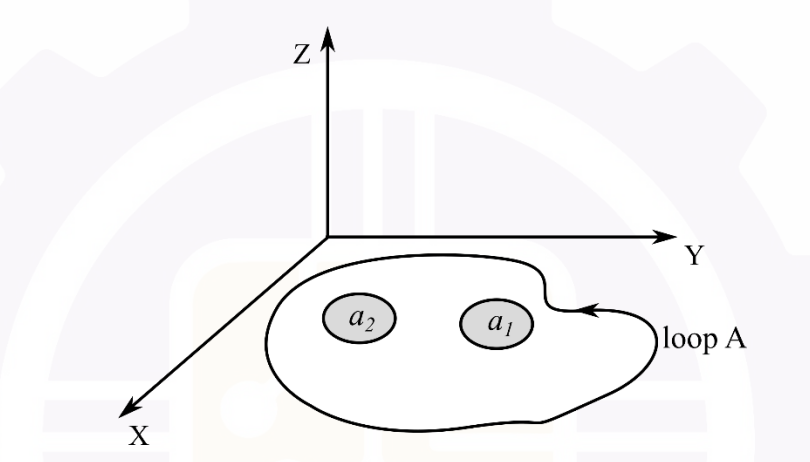
What is the expression for the induced rms voltage in loop A?
For a tightly wound coil of wire, composed of N identical turns, each with the same ΦB, ________ of induction states that \(\varepsilon=-\dfrac{d\Phi_B}{dt}\) where N is the number of turns of wire and ΦB is the magnetic flux through a single loop.
Two resistors are connected in a circuit loop of area $5 \ m^2$, as shown in the figure below. The circuit loop is placed on the x-y plane.
When a time-varying magnetic flux, with flux-density $B(t) = 0.5t$ (in Tesla), is applied along the positive z-axis, the magnitude of current $I$ (in Amperes, rounded off to two decimal places) in the loop is __________.
If a copper conductor is moved across a magnetic field -
- Faraday's law of electromagnetic induction is mathematically described by which one of the following equations?


