
Double Slit Fringe Shift Explained
In a double-slit experiment, introducing a transparent sheet in front of one slit changes the optical path length, causing the interference pattern to shift. The shift occurs because the light travels slower through the sheet, increasing the path length.
Calculating Path Difference
The path difference introduced by a transparent sheet of thickness $t$ and refractive index $n$ is given by the formula:
$ \Delta = (n-1)t $
Where:
- $n$ is the refractive index of the sheet ($n = 1.56$).
- $t$ is the thickness of the sheet ($t = \alpha \times 10^{-9} \text{ m}$).
Fringe Shift Condition
When the central fringe (originally at the center, order $m=0$) shifts to the position of the $m^{th}$ bright fringe, the path difference introduced by the sheet is equivalent to $m$ wavelengths of the light source.
In this problem:
- The central fringe shifts to the position of the $7^{th}$ bright fringe, so $m = 7$.
- The wavelength of light is $\lambda = 450 \text{ nm} = 450 \times 10^{-9} \text{ m}$.
Therefore, the condition becomes:
$ (n-1)t = m\lambda $
Determining Mica Sheet Thickness
Substitute the known values into the equation:
$ (1.56 - 1) \times (\alpha \times 10^{-9} \text{ m}) = 7 \times (450 \times 10^{-9} \text{ m}) $
Simplify the equation:
$ 0.56 \times \alpha \times 10^{-9} = 3150 \times 10^{-9} $
Cancel out the $10^{-9}$ term from both sides:
$ 0.56 \alpha = 3150 $
Solve for $\alpha$:
$ \alpha = \frac{3150}{0.56} $
$ \alpha = 5625 $
The thickness of the mica sheet is $5625 \times 10^{-9} \text{ m}$.
Similar Questions
- In a microscope the objective is having focal length $f_o = 2 \text{ cm}$ and eye-piece is having focal length $f_e = 4 \text{ cm}$. The tube length is $32 \text{ cm}$. The magnification produced by this microscope for normal adjustment is ____________.
- A collimated beam of light of diameter $2 \text{ mm}$ is propagating along x-axis. The beam is required to be expanded in a collimated beam of diameter $14 \text{ mm}$ using a system of two convex lenses. If first lens has focal length $40 \text{ mm}$, then the focal length of second lens is ____________ $\text{mm}$.
- In a Young's double slit experiment set up, the two slits are kept $0.4\text{ mm}$ apart and screen is placed at $1\text{ m}$ from slits. If a thin transparent sheet of thickness $20 \, \mu\text{m}$ is introduced in front of one of the slits then center bright fringe shifts by $20\text{ mm}$ on the screen. The refractive index of transparent sheet is given by $\frac{\alpha}{10}$, where $\alpha$ is __________.
- In two separate Young's double-slit experimental set-ups and two monochromatic light sources of different wavelengths are used to get fringes of equal width. The ratios of the slits separations and that of the wavelengths of light used are $2 : 1$ and $1 : 2$ respectively. The corresponding ratio of the distances between the slits and the respective screens ($D_1/D_2$) is ___________.
- The size of the images of an object, formed by a thin lens are equal when the object is placed at two different positions $8 \text{ cm}$ and $24 \text{ cm}$ from the lens. The focal length of the lens is ________ $\text{cm}$.
- If sunlight is focused on a paper using convex lens, it starts burning the paper in shortest time when the lens is kept at $30\text{ cm}$ above the paper. If the radius of curvature of the lens is $60\text{ cm}$ then the refractive index of the lens material is $\frac{\alpha}{10}$. The value of $\alpha$ is __________.
- An unpolarized light of intensity $I_0$ passes through polarizer and then through a certain optically active solution and finally it goes to analyser. If the angle between analyser and polariser is $0^\circ$ and intensity of light emerged from analyser is $\frac{3}{8} I_0$, the angle of rotation of the light by the solution with respect to analyser is _________ degrees.
A ring is placed at the bottom of a trough containing four immiscible liquids of refractive indices $1.0, 2.0, 3.0$ and $4.0$ poured one above the other of heights $10$ cm, $20$ cm, $30$ cm, and $40$ cm respectively. The apparent depth at which the ring appears, when seen from outside is____________ cm.
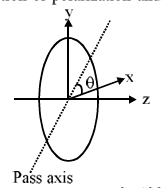
A plane polarized light is incident on a polariser with its pass axis making angle $\theta$ with x-axis, as shown in the figure. At four different values of $\theta$, $\theta = 8^\circ, 38^\circ, 188^\circ$ and $218^\circ$, the observed intensities are same. What is the angle between the direction of polarization and x-axis ?
- A convergent doubled to separated lenses, corrected for spherical aberration, has resultant focal length of 10 cm. The separation between the two lenses is 2 cm. The focal lengths of the component lenses are :
Important Questions from Optics
- In a microscope the objective is having focal length $f_o = 2 \text{ cm}$ and eye-piece is having focal length $f_e = 4 \text{ cm}$. The tube length is $32 \text{ cm}$. The magnification produced by this microscope for normal adjustment is ____________.
- A collimated beam of light of diameter $2 \text{ mm}$ is propagating along x-axis. The beam is required to be expanded in a collimated beam of diameter $14 \text{ mm}$ using a system of two convex lenses. If first lens has focal length $40 \text{ mm}$, then the focal length of second lens is ____________ $\text{mm}$.
- In a Young's double slit experiment set up, the two slits are kept $0.4\text{ mm}$ apart and screen is placed at $1\text{ m}$ from slits. If a thin transparent sheet of thickness $20 \, \mu\text{m}$ is introduced in front of one of the slits then center bright fringe shifts by $20\text{ mm}$ on the screen. The refractive index of transparent sheet is given by $\frac{\alpha}{10}$, where $\alpha$ is __________.
- In two separate Young's double-slit experimental set-ups and two monochromatic light sources of different wavelengths are used to get fringes of equal width. The ratios of the slits separations and that of the wavelengths of light used are $2 : 1$ and $1 : 2$ respectively. The corresponding ratio of the distances between the slits and the respective screens ($D_1/D_2$) is ___________.
- The size of the images of an object, formed by a thin lens are equal when the object is placed at two different positions $8 \text{ cm}$ and $24 \text{ cm}$ from the lens. The focal length of the lens is ________ $\text{cm}$.


